
A contractor needs a continuous run through a crowded service route. An equipment builder needs repeatable straight sections on a production fixture. Both may specify copper with the same outside diameter, yet the most practical material condition can differ.
The choice between soft copper tubing and hard copper tubing depends on the installation route, forming requirements, connection strategy, and the applicable product and system requirements. In this article, you will not only learn about soft and hard copper tubing and the differences between them but also discover how to make the right purchasing decisions.
Executive Summary
- Choose a temperature around the approved forming process and installation route.
- Specify tube standard, outside diameter, and wall separately from softness or hardness.
- Compare joint count, handling, usable lengths, and inspection requirements alongside price.
- Review pressure ratings for the material condition after joining and fabrication.
What Soft and Hard Copper Tubing Actually Describes
Temper Is a Material Condition
“Soft” and “hard” describe the tube’s material condition, commonly called temper. Annealing softens copper after working; drawing changes its mechanical condition. These words do not describe separate purity classes. Two tubes can share an alloy designation while arriving in different tempers.
Keep the alloy, temper, and dimensions in separate fields on an RFQ. This prevents a seller from treating a familiar product name as a complete specification. When the drawing includes a recognized temper designation, reproduce it exactly and ask the manufacturer to identify the governing standard.
Terms also vary by market and product family. We would avoid translating “half-hard” into an unrelated temper code without confirmation. Our copper tube standards guide explains why the product reference and material condition need to travel together through the purchasing documents.
Coil Shape Does Not Prove Temper
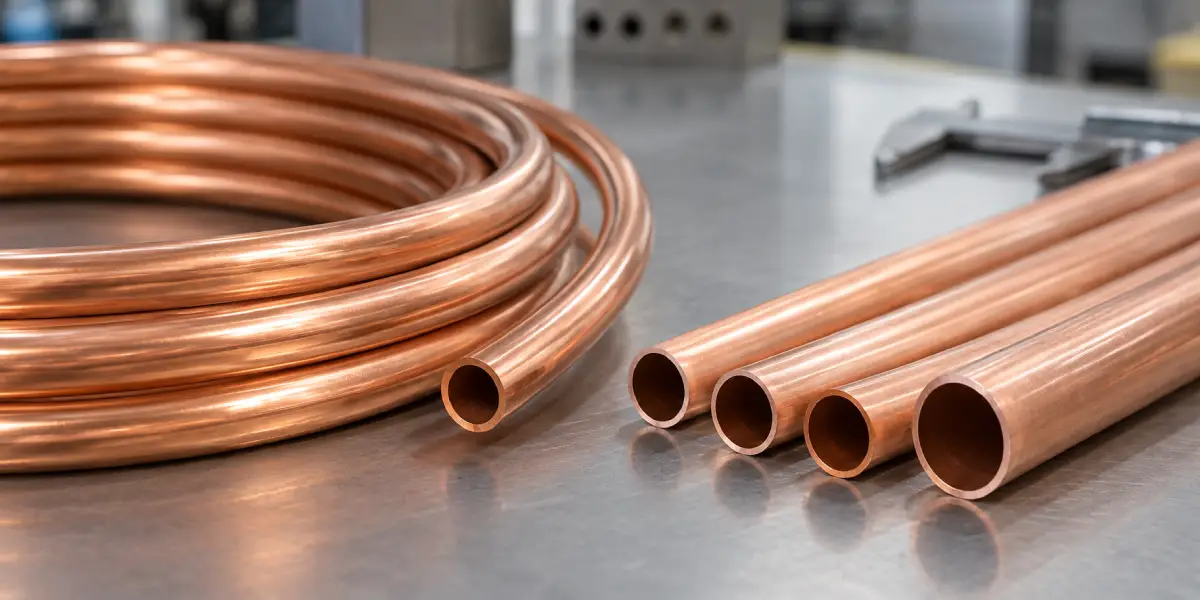
A flat coil usually suggests a flexible field-installation product, while a straight bundle suggests a rigid tube. Those are useful visual clues, not acceptance evidence. Industrial coils are available in more than one material condition, and a straight delivery form does not universally mean hard temper.
For a documented example, Mueller Streamline’s level-wound tube literature describes light-annealed, soft-annealed, and hard-tempered supply. That range shows why a photograph of a coil cannot establish the condition of the metal. It describes the manufacturer’s offering, not a claim about every supplier.
Soft Copper Tube for Bending and Continuous Runs
Routes With Several Changes of Direction
An annealed coil can be useful when the approved route contains gradual changes of direction and a continuous length is practical. The benefit depends on whether the available coil can be handled and formed without unacceptable flattening or damage.
Start with the route drawing. Check where the tube enters the building, where bending tools can fit, and whether installers can guide the length without dragging it over abrasive edges. A narrow shaft may make one long piece harder to manage than the purchase description suggests.
When reviewing ACR copper coils, ask for the specified length, outside diameter, wall, and temper as one item. Treat “easy to bend” as a question about the actual tube and process. A supplier cannot establish the result from diameter alone or from a sample of a different wall.
Fewer Joints Need a Real Layout
Longer supplied lengths may reduce intermediate joints, but the route determines how much benefit remains after cutting. Equipment connections, branches, and approved service arrangements still need their designated joints. Count those before claiming any savings.
Consider a hypothetical comparison: one route can use a single continuous length, while a second proposal divides that same route into three lengths. The second arrangement adds two intermediate connection locations. That is a planning observation, not a measured installation saving or a prediction of leakage.
We would price the corresponding fittings, preparation, and inspection work, then ask whether either option introduces a handling problem. Repeatedly bending a damaged section back into shape is not a sensible way to recover the supposed advantage. Keep a defined acceptance method for fabricated bends and a clear process for replacing damaged material.
Hard Copper Pipe for Straight Runs and Fabrication
Alignment and Support Access
A drawn tube can suit an exposed run where straight alignment matters or a fixture that locates straight components before assembly. Its rigidity can simplify positioning, although the design must still provide appropriate supports and accommodate movement.
A clean drawing should identify connection locations, support access, and any clearance needed for joining tools. Installation planning becomes difficult when a purchasing description specifies rigid lengths but the actual work area cannot accept them. Check delivery access and the route from the unloading point to the installation area before fixing the supplied length.
For a hypothetical plant-room project, we would compare a straight section assembled in place with a prefabricated section brought through the doorway. The tube choice may be identical; the practical difference is assembly access. That decision belongs in the work plan before the supplier packs long straight lengths.
Hard Tube Can Sometimes Be Bent
The statement that hard copper can never be bent is too broad. The Copper Development Association’s bending guidance describes bending both annealed and drawn tube with appropriate equipment. Suitability depends on the tube, its condition, and the tooling.
This does not authorize bending every hard tube on a general-purpose hand bender. Ask the fabricator to confirm the tool’s permitted material, OD, wall, and bend geometry. A small sample trial should represent the actual production condition, including any end forming that follows the bend.
If the proposed process requires local heating, review the resulting material condition and inspection requirements before accepting it. A field workaround can alter assumptions used in design. We recommend documenting the approved sequence so purchasing does not order one temper while fabrication quietly converts it into another.
Compare Soft and Hard Copper Tube Requirements
Dimensions, Cleanliness, and End Protection
Use this comparison to organize questions rather than to assign a universal winner. Both columns still require a complete product specification.
| Comparison Point | Soft / Annealed Copper Tube | Hard / Drawn Copper Tube | Selection Boundary |
|---|---|---|---|
| Forming tendency | Usually easier to bend and form plastically. | More resistant to permanent deformation; bending requires suitable tools and defined process conditions. | Compare tubes of the same alloy and size. Wall thickness, tooling, and bend geometry still matter. |
| Typical selection tendency | Consider it where continuous lengths and routing around suitable paths are important. | Consider it where straight runs, exposed alignment, or fixture-based assembly are important. | These are selection tendencies, not exclusive applications. |
| Supply form | May be supplied in coils and may also be available in straight lengths. | Commonly supplied in straight lengths; hard-temper industrial coils are also available. | Supply shape does not replace temper certification. |
| Joints and installation cost | A continuous length may reduce intermediate connection locations. | Straight-run layouts should include the required connection and assembly work in the comparison. | Compare both options on the same actual route; neither option is always less expensive. |
For refrigerant service, inspect the specified internal condition and end protection regardless of temper. Softness does not prove that a tube was prepared for refrigeration. Our ACR copper tube buying guide addresses those requirements in more detail.
Dimensions deserve the same separation. A thicker wall and a harder temper are different attributes. When two quotations differ, identify each change independently so the technical reviewer can see what the proposed substitution actually alters.
Pressure and Joining Conditions
Never select the material condition from a standalone burst-pressure claim. The design assessment needs the applicable working conditions, tube dimensions, and joint requirements. The completed assembly must remain within the limits accepted for its intended service.
CDA pressure-rating guidance states that brazed or welded drawn tube uses the corresponding annealed rating because joining heat can soften it. A quotation describing a hard tube therefore does not automatically support using a hard-condition pressure rating throughout the finished assembly.
Before accepting a substitution, resolve these questions together:
- Does the selected tube meet the approved product specification?
- Does the joining method change the assumed material condition?
- Do the fittings and connections suit the operating conditions?
- Has the responsible technical reviewer accepted the revised arrangement?
Record the decision against the item code. That makes an approved change visible to purchasing and inspection instead of leaving it in a conversation only one person remembers.
Which Option Gives the Better Purchasing Result?
Compare Usable Material and Work
Coil price and straight-length price can hide different quantities. Convert offers to the same usable-length basis, then compare the other requirements. A low price per piece may represent a shorter piece, a different wall, or a package that needs additional preparation.
| Cost element | What to compare | Evidence to request |
|---|---|---|
| Purchased quantity | Usable length after planned cuts | Cutting plan and length tolerance |
| Connection work | Required intermediate joints | Approved route or assembly drawing |
| Handling | Uncoiling, straightening, or long-length access | Proposed delivery form |
| Rework exposure | Defined bend and end acceptance | Sample or first-piece review |
A price comparison becomes more useful when it names the work each option creates. We would keep assumptions visible: labor rates, expected cut lengths, and packaging needs. These estimates belong to the buyer’s project calculation; they should not be presented as universal cost percentages.
Plan Storage and Transport
Soft coils need protection against crushing and uncontrolled handling. Straight tubes need packaging and handling arrangements that preserve their shape and ends. Each delivery form can arrive damaged if its supports or restraints do not suit the shipment.
Explain how material will move through the receiving area. If forklifts handle the pallet but installers later carry individual packages, consider both stages. Ask the supplier to show how item labels remain identifiable after a partial quantity is removed.
For mixed orders, avoid grouping visually similar materials under one broad description. A clear package label should let the receiving team distinguish diameter, wall, and temper without opening every bundle. We also recommend recording how unused, opened material will be protected between work shifts. Good delivery packaging does not protect a tube once it has been left exposed on site.
How to Order Soft or Hard Copper Tubing
Write a Complete Supplier Brief.
We can discuss the trade-offs more efficiently when the inquiry explains what happens after delivery. Include a route drawing for installation work or a component drawing for fabrication. Tell the supplier which details are approved and which remain preliminary.
- List the governing standard, alloy where required, OD, and wall limits.
- State temper and delivery form as separate requirements.
- Describe bending, straightening, flaring, or other planned processing.
- Specify lengths, quantities, end protection, and packaging needs.
- Request confirmation of deviations and required inspection records.
For Nexnice inquiries, identify the actual use rather than relying on “soft copper” or “hard pipe” as the complete request. If a technical requirement is unresolved, flag it before the offer becomes a purchase order. That allows the quotation to show its assumptions explicitly.
Check a Representative First Delivery
An initial delivery review should connect the paperwork to the material the workshop will actually use. Check item identity before evaluating forming performance. A successful trial on a sample from another size or temper does not validate the ordered batch.
- Match package and batch identification to the order.
- Check agreed sample dimensions and delivery condition.
- Review a representative formed or assembled piece where specified.
- Record deviations and obtain disposition before release.
Keep any accepted sample or first-piece record with the drawing revision. If a later order changes the temper, wall, or supplied form, ask whether the earlier approval still applies. This is especially useful for distributors serving several contractors, where a familiar product name can conceal different customer requirements.
Make the Choice Around the Finished Assembly
Choose soft or hard copper by working backward from the approved assembly and processing route. Then specify dimensions, material condition, service requirements, and delivery form clearly. The best purchasing choice is the one the installation or production team can use as intended, with the assumptions documented before shipment.
Frequently Asked Questions
Is soft copper weaker than hard copper?
Annealed and drawn copper have different mechanical properties, but “weaker” is too vague for selection. Assess the tube dimensions, operating conditions, and joining process together. The material condition after fabrication may differ from the condition stated on the delivery label.
Can hard copper tubing be bent?
Yes, some drawn copper tubes can be bent with appropriate equipment. Check the specific tube and tool limitations because diameter, wall, temper, and bend geometry affect the process. Do not treat that general capability as permission for unrestricted field bending.
Is soft copper suitable for refrigeration?
Yes, when the particular product meets the refrigeration specification and system requirements. Softness alone does not prove internal cleanliness, suitable dimensions, or pressure capability. Confirm the tube standard and equipment requirements before choosing an annealed coil for a refrigerant line.
Does a copper coil always mean soft tube?
No. Industrial coils can be supplied in different material conditions, including hard temper in some product ranges. Confirm the temper on the quotation and product identification because the winding shape describes the supplied package rather than fully defining the metal.
Which copper temper costs less to install?
The answer depends on the route and fabrication work. Compare usable lengths, intermediate joints, forming, supports, and handling under the actual project conditions. Either temper can create extra work if its delivery form or processing requirements don’t suit the job.
Request a Quote
Send Nexnice your required dimensions, temper, quantities, and intended forming or installation method. Include the relevant drawing and delivery requirements. Request a copper tube quotation so we can discuss the specified configuration and clarify any outstanding details.