
Two copper coils may have similar fins, bends and connections while doing opposite jobs. A condenser rejects heat as refrigerant changes toward liquid; an evaporator absorbs heat as refrigerant changes toward vapor. Their names describe those thermodynamic roles, not a unique copper alloy or a permanent location indoors or outdoors.
Understanding the difference helps an engineer read a coil specification and a technician interpret operating measurements. For the wider equipment context, see the copper heat exchanger guide. Here the focus is the conventional subcritical vapor-compression cycle, rather than a transcritical gas cooler.
Executive Summary
- The condenser and evaporator handle different refrigerant states and heat duties.
- A dry-expansion evaporator is commonly evaluated with outlet superheat; a condenser’s liquid outlet may be evaluated with subcooling.
- Refrigerant temperature must be interpreted with pressure and the correct saturation reference.
- Similar copper construction does not establish interchangeability, particularly when circuitry and control requirements differ.
- In a reversible heat pump, each coil must be assessed in both operating roles.
Follow the Refrigerant Through Each Coil
Condenser: remove heat and form liquid
Refrigerant normally reaches the condenser as high-pressure vapor from the compressor. In a typical cycle, it first loses superheat, then condenses, and may leave with additional liquid subcooling. These regions need not occupy equal fractions of the coil, and their proportions change with operation.
The condenser must reject the energy absorbed on the cold side plus the work added to the refrigerant by the compressor. For an idealized steady cycle neglecting other heat losses, Qcond = Qevap + Wcomp. Thus, the evaporator’s cooling duty alone is not the condenser’s required heat-rejection duty.
Evaporator: absorbs heat and produce vapor
After the expansion device, low-pressure refrigerant enters the evaporator, commonly as a liquid-vapor mixture. Heat from the cooled air or liquid drives further evaporation. In a dry-expansion arrangement, the outlet region provides superheat after evaporation is complete. For systems using a fixed restriction, the refrigeration capillary matching guide addresses the upstream metering decision.
This article does not apply that outlet description to every evaporator. Flooded and other arrangements use different liquid-management strategies. Establish the equipment type before deciding what an outlet measurement should mean.
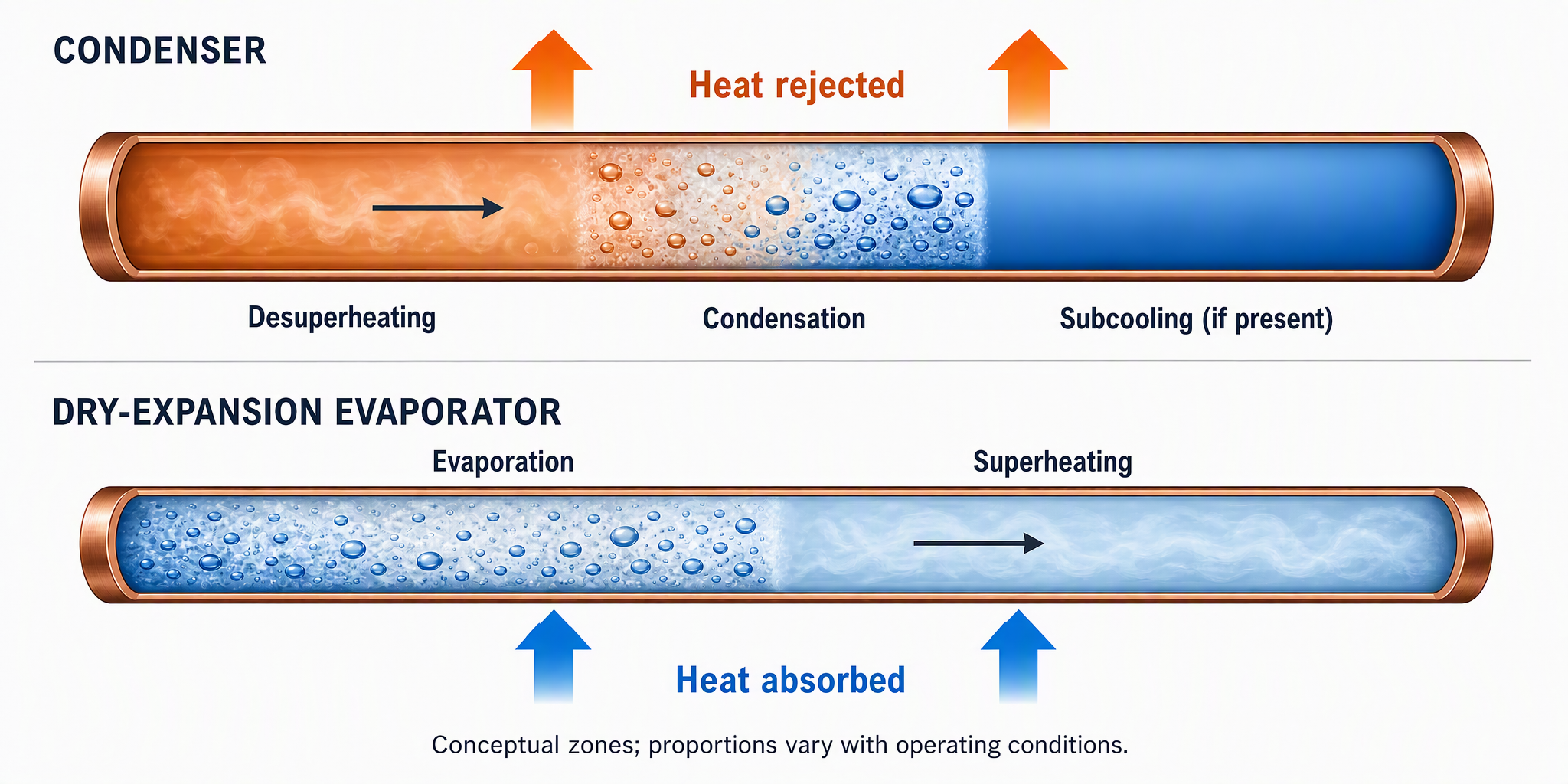
Compare Roles Before Comparing Copper Dimensions
| Question | Condenser | Dry-expansion evaporator |
|---|---|---|
| Main energy direction | Rejects heat to the surroundings | Absorbs heat from the cooled medium |
| Typical phase progression | Vapor toward liquid | Mixture toward vapor |
| Useful outlet state check | Liquid condition and subcooling where specified | Vapor condition and superheat |
| External-side concern | Ability to remove rejected heat | Ability to supply cooling load and manage moisture/frost where relevant |
| Replacement basis | Rated heat rejection and circuit conditions | Rated cooling and distribution/control conditions |
Copper’s presence on both sides does not remove these differences. Tube dimensions, headers, circuit arrangement, fins and connections must suit the role and the operating envelope. A matching face area or connection size answers only part of a replacement question.
Interpret Superheat and Subcooling Correctly
Superheat needs a pressure reference
Superheat is the vapor temperature above the saturation temperature corresponding to the local pressure. A warm suction-line temperature by itself does not establish high superheat: the saturation reference must be known. Measurements also need defined locations because pressure and temperature can change along the line.
Danfoss describes how a thermostatic expansion valve responds to evaporator outlet conditions. That feedback function belongs to the valve and control arrangement. It should not be confused with a fixed capillary tube, which has no equivalent sensing bulb and modulating mechanism.
Subcooling describes liquid below saturation
Subcooling compares the liquid temperature with its saturation reference at the relevant pressure. The required amount is equipment-specific. Do not use one universal target to judge every condenser or to decide that a particular charge is correct.
For refrigerants with temperature glide, use the correct refrigerant property reference and the equipment procedure. Dew-point and bubble-point values are not interchangeable. Danfoss’s refrigerant tools distinguish both, which is why an unexplained “saturation temperature” entry can be inadequate in a test report.
Distinguish a Coil Problem From a System Problem
Start with what changed
A reported loss of cooling does not identify which component caused it. Review the external fluid conditions, operating load, and controls alongside refrigerant measurements. For an air coil, note airflow, face condition, and any ice or condensate behavior before attributing the result to the copper tube.
A useful comparison is a repeatable operating record: ambient or fluid inlet temperature, air or liquid flow, pressures, temperatures at named points, and equipment operating state. Compare it with an approved baseline at comparable conditions. A photograph and a single pressure value rarely support a confident diagnosis.
Keep tube enhancement claims in context
An internal enhancement may be assessed differently in evaporation and condensation. Request relevant data rather than assuming one capacity improvement applies in both roles. The same principle applies when changing circuit count: the revised distribution must be evaluated under the intended conditions.
For OEM tubing requirements, see Nexnice’s inner-grooved copper tubes and the dimensions and groove details needed for a quotation. Suitability for a condenser, an evaporator, or a reversible coil must still be checked against the specified operating conditions.
This is a thermal-design question before it is a materials substitution question. Do not choose a replacement solely because it uses the same copper OD or has a visually similar fin pack.
What Changes in a Reversible Heat Pump?
When refrigerant flow is reversed, a coil may switch between absorbing and rejecting heat. A design that performs well in one mode still needs review in the other. Connections, distribution and operating controls must accommodate both duties.
Outdoor operation also introduces mode-dependent external conditions. A development test should include the specified heating and cooling conditions and any relevant defrost behavior. The test plan should come from the equipment’s actual operating envelope, not from an assumption that reversing flow guarantees equal capacity.
For a Nexnice component discussion, label the coil’s required roles on the drawing. Providing only “condenser tube” can hide the fact that the same component must also serve as an evaporator in another mode.
Conclusion
The difference between condenser and evaporator tubing begins with the job performed by the refrigerant circuit. Follow the phase change, energy flow and control requirements before comparing physical dimensions. For reversible equipment, a complete specification must explain both operating modes.
Frequently Asked Questions
Is the outdoor coil always the condenser?
No. That description applies to many air conditioners operating in cooling mode, but a reversible heat pump can change the coil’s role. Identify whether the coil is rejecting or absorbing heat in the current mode before naming its function.
Why is condenser duty larger than evaporator duty?
In an idealized steady refrigeration cycle, the condenser rejects the evaporator’s absorbed heat plus compressor work delivered to the refrigerant. Actual energy accounting must also consider relevant losses. Cooling capacity alone therefore does not completely specify heat-rejection duty.
Can similar-looking coils be interchanged?
Appearance does not establish equivalence. Compare rated duty, pressure and temperature conditions, circuit layout, connections and control requirements. A replacement also needs to meet the installation envelope and any operating modes specified by the equipment designer.
Does suction-line temperature directly equal superheat?
No. Superheat is a temperature difference relative to saturation at the corresponding pressure. Identify the measurement location and refrigerant property reference. Without that information, a suction-line temperature alone cannot establish the evaporator outlet’s superheat condition.
Do reversible coils need separate performance checks?
Yes. A coil operating as both condenser and evaporator experiences different refrigerant and external-side conditions. Check each specified mode and relevant transitions through the equipment’s approved development process rather than assuming that performance transfers unchanged when flow reverses.
Define the Coil’s Operating Roles
Send Nexnice the circuit drawing and required heating or cooling modes using the coil application contact form. Identify the expected refrigerant states and rating conditions so the component request reflects its actual duty.