
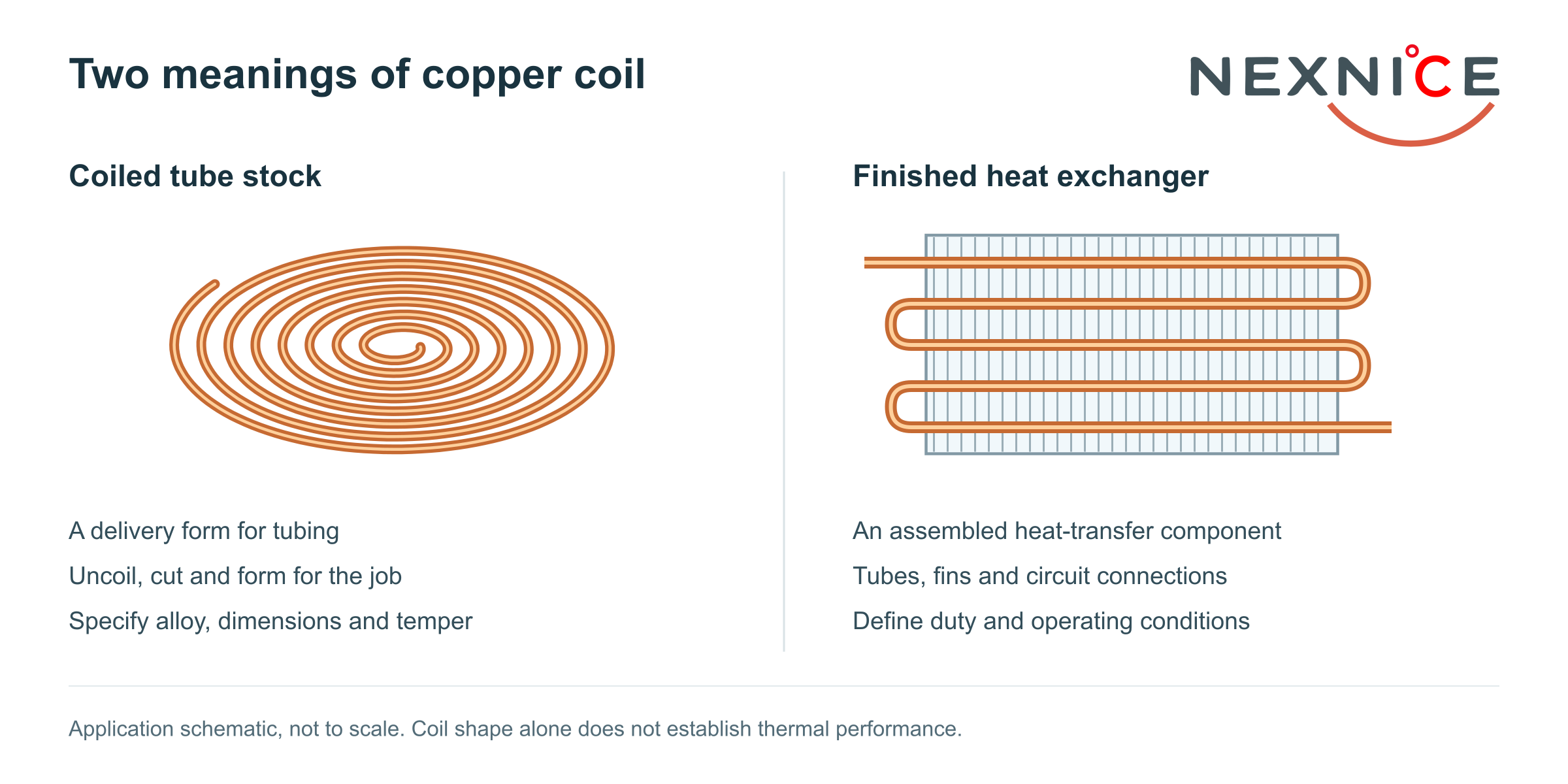
In HVAC and refrigeration, “copper coil” can mean copper tubing supplied in a winding or an assembled heat exchanger containing copper tubes. These are different products. Tube stock is uncoiled and fabricated; a finished coil has an assigned heat duty, connections, and construction. Electrical copper-wire windings are outside this guide’s scope.
For a buyer, the first question is therefore what must arrive: raw tube for a production line, tubing for an installation, or a finished heat-transfer component. This guide explains the forms, uses, and specification choices behind that decision.
Executive Summary
- Coil form controls storage, feeding, bending access, and usable installation length.
- Copper grade, temper, outside diameter, wall, cleanliness, and end protection must be specified together.
- A compact winding does not prove a particular heat-transfer capacity or pressure rating.
- HVAC, refrigeration, heat-transfer, plumbing, and process uses impose different acceptance conditions.
Start With the Fluid Circuit
Define what travels through the tube
Record the fluid, design pressure, temperature range, phase changes, flow direction, and cleaning exposure. Refrigerant service may require ACR cleanliness and sealed ends; a water process coil may prioritize corrosion chemistry, drainability, and access for cleaning. The same OD can therefore lead to different material and inspection requirements.
Separate coil shape from thermal duty
A coil can add length or surface area inside a vessel, but its actual duty depends on fluid properties, flow, wall resistance, outside convection, fouling, and temperature difference. Do not turn a catalog winding diameter into a heat-output promise. Establish the duty and test conditions before asking a supplier to suggest a form.
Choose the Winding Form
Pancake coils
A pancake coil supplies tubing in a flat circular package for storage and payout. Nexnice’s ACR pancake copper coils are an example of this delivery form for refrigeration pipework. The package is not a finished heat exchanger: tube dimensions, temper and the installed route still need to be specified.
Level wound coils
Level wound coils arrange tube in successive, orderly layers for continuous feeding. A spool is optional in some supply specifications, so confirm the actual package and payout method. The detailed guide to pancake and level wound coils explains how these forms interact with handling equipment.
Straightened or cut lengths
A straight length may be the better delivery form when a machine performs its own bending or when each circuit needs a measured piece. Whether this adds joints depends on whether each cut piece covers its complete circuit. The selection should compare total operations, not only the price per kilogram.
Where Copper Coils Are Used
Refrigerant circuits
An evaporator coil transfers heat into refrigerant; a condenser transfers heat out to air or water. In a fin-and-tube assembly, the copper tubing forms the fluid passage while the external fin pack provides additional airside area. The winding used to ship the original tubing does not determine which role the finished coil performs.
Water heating and cooling
Coils can also transfer heat between circulating water and air, or between a fluid inside the tube and liquid around an immersed coil. These duties need a fluid-compatibility and temperature review. A refrigeration designation alone does not settle suitability for a particular water chemistry. See copper coil applications in HVAC for the differences between these duties.
Benefits with practical limits
Copper offers a useful combination of heat conduction and fabrication options for tubing. Coiled stock can supply a continuous piece that would otherwise need a joint, provided the available length and forming route suit the installation. Neither benefit makes every copper coil interchangeable. Material condition, tube dimensions, and service environment still determine whether the proposed component is suitable.
Specify Material and Dimensions Together
Use a complete dimensional callout
State the material grade and applicable tube specification, OD, wall thickness, and whether it is nominal or minimum, temper, dimensional tolerances, and required length or coil mass. If the job requires an uninterrupted length, specify that minimum separately rather than relying on coil mass alone. If the tube will be expanded, brazed, or mechanically formed, include the post-forming acceptance condition. Wall thickness affects internal area and pressure margin; it is not a cosmetic detail.
Protect cleanliness and ends
For refrigeration service, define cleaning, capping, packaging, and storage requirements. End damage can make an otherwise conforming coil unusable at the first connection. Ask for lot identification and inspection records that match the delivered coil.
Design the Installation Before Ordering
Check access and bending clearance
Measure the path, entry opening, support points, and tool clearance. A compact coil may be easy to ship but difficult to uncoil without kinking. Include the required minimum bend radius and a visual or dimensional check after forming.
Plan for joining and inspection
Decide where brazed, flared, or mechanical joints will occur. The joint method determines end preparation, cleaning, and leak-test needs. If the purchase specification omits joint requirements, the delivered tube may meet its dimensional limits yet still be unsuitable for the intended connection.
Compare a Supplier Offer
Use a short acceptance table: requested OD and wall; delivered temper; coil geometry; length or mass; end condition; cleanliness; test documents; packaging; and permitted deviations. For each requirement, ask the supplier to state the offered value or condition, confirm whether it meets the specification, and identify the supporting inspection method and sampling basis where applicable. List deviations separately and obtain approval before production.
Conclusion
“Copper coil” describes either coiled tube stock or a working heat-exchanger assembly, depending on context. Identify which product you need first. Then connect the delivery form to the fabrication process and the tube specification to the fluid service. A useful buying brief makes those relationships explicit instead of asking one package label to define the entire product.
Frequently Asked Questions
Is every copper coil suitable for refrigeration?
No. Refrigeration service may require a specific alloy, cleanliness level, capped ends, and pressure or leak-test evidence. A visually similar plumbing or process coil does not automatically meet those conditions. Match the tube designation and preparation to the refrigerant circuit and applicable specification.
Does a larger coil always transfer more heat?
No. Length and area matter, but fluid flow, temperature difference, fouling, wall resistance, and the outside heat-transfer environment also control duty. Do not infer pressure drop or flow distribution from winding diameter alone. Check the tube length, bore, circuit arrangement, and flow conditions, then compare thermal performance and pressure drop at the specified operating point.
Should I buy a pancake or level wound coil?
Choose pancake when a manageable package suits field payout; choose level wound when controlled long-length feeding fits the production process. The final decision should include the uncoiling method, bend limits, end orientation, and installation equipment.
What should a coil quotation include?
Request material grade and applicable tube specification, OD, wall, temper, coil form, dimensions, quantity, end protection, cleanliness, inspection records, packaging, and permitted tolerances. Add the service fluid, pressure, temperature, joining method, and applicable project and installation requirements so the supplier can identify an appropriate configuration.
Can a coil be substituted by a straight tube?
Sometimes, but the substitution changes handling, forming, joints, and possibly residual stress. Confirm that the straight length can be bent without violating radius, wall, cleanliness, or circuit requirements. Treat it as an engineering change requiring documented acceptance, not as an interchangeable package label.
Request a Quote
Contact NEXNICE for copper tubing supplied in coils. Include the material grade, applicable tube specification, OD, wall thickness, temper, coil format, required length or mass, end protection, and inspection requirements. State the service fluid, design pressure, temperature range, and intended joining method. For tubing used in a heat exchanger, provide the tube requirements established by the equipment designer; the tubing supply specification does not establish the finished assembly’s thermal performance.