
A coil that works well for a contractor can be awkward on an automated production line. The contractor may need a manageable length for one installation. The factory needs a package that feeds its equipment reliably and matches the approved tube specification.
The main copper coil types discussed here are pancake coils and level-wound coils. These names describe winding and delivery formats. They do not fully define alloy, temper, wall thickness, or internal profile. Insulation and end preparation add further choices.
We start with what happens when the package is opened. That makes the comparison useful for HVAC buyers, distributors, and OEM teams who must turn a supplied coil into installed piping or finished components.
Executive Summary
- Match the coil format to field handling or the production feeding system.
- Specify winding geometry, tube dimensions, and material condition separately.
- Confirm usable length, end condition, and any policy on interruptions.
- Review handling equipment and packaging before choosing larger coils.
- Compare cost per accepted output using the buyer’s actual production assumptions.
What Is a Pancake Copper Coil?
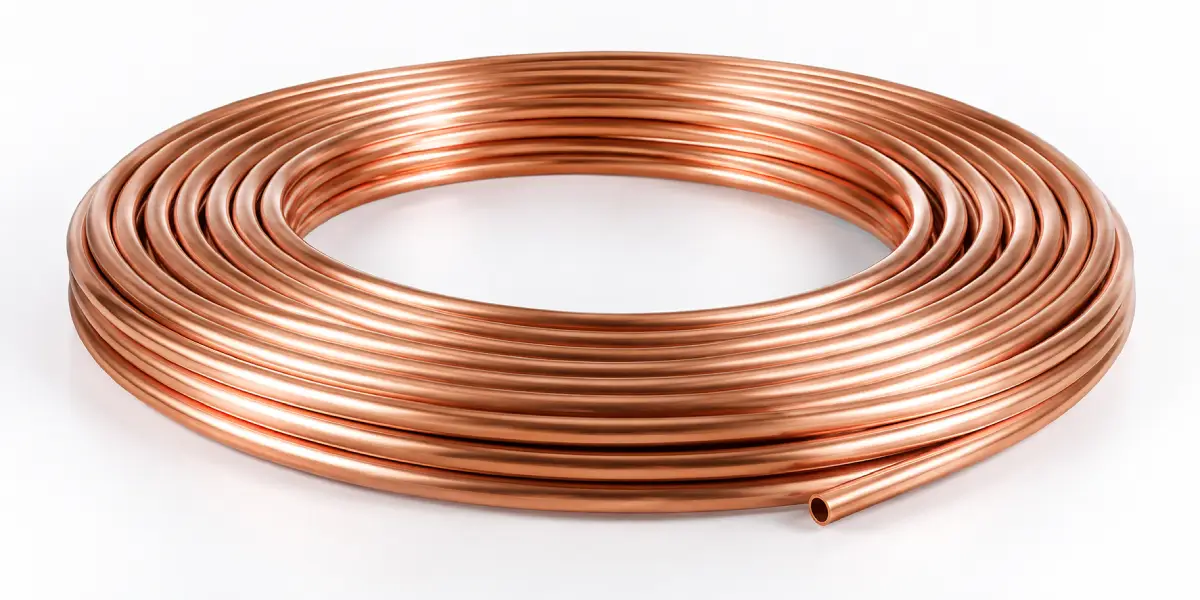
A Flat Format for Manageable Lengths
A pancake coil is wound into a relatively flat circular package. Buyers commonly encounter this format when sourcing annealed tubing for field work. Its practical value depends on whether the supplied length and package can be handled through the intended installation route.
For ACR pancake copper coils, confirm the tube standard, OD, wall, temper, and length rather than ordering from shape alone. Ask whether the coil is supplied as the continuous length required by the job and how its ends are protected.
A compact package can still be difficult to use in a confined space if there is no room to unroll it in a controlled way. We recommend considering the route from carton to installation position, including how the remaining tube will be supported while the first section is guided into place.
Field Use Needs Controlled Uncoiling
Uncoiling should preserve the tube’s condition and follow the product’s handling guidance. Pulling material through an unsuitable arrangement can introduce twists, flattening or surface damage. A convenient package does not remove the need for a suitable method.
Think through a hypothetical renovation job with a narrow access corridor. A supplied coil may fit through the doorway easily, but the installer still needs somewhere to open and guide the length. Choosing a delivery quantity without that space can create extra handling.
We would ask the installation team to confirm how much material is needed for each approved route and how the opened remainder will be stored. Purchasing then has a basis for selecting coil lengths. This is more useful than assuming that the largest available package always reduces the total work.
What Is a Level Wound Copper Coil?
Layered Winding for Production Feeding
A level wound coil arranges the tube in controlled layers for a defined delivery package. It is commonly considered when a manufacturer needs longer feeding runs into equipment such as straightening, cutting or forming machinery.
The winding format needs to match the feeding arrangement. Specify the coil’s inside diameter, outside diameter, width or height as applicable, and the required delivery orientation. Ask the equipment team which dimensions are mandatory and which can vary within an agreed range.
When reviewing level wound copper coils, provide the feeding-equipment requirements with the tube specification. A product that satisfies the metal dimensions may still be unsuitable for the available payoff equipment. Resolving the packaging interface before shipment avoids leaving that decision to the machine operator at the start of production.
Coil Weight Does Not Define Usable Output
A larger mass per coil does not automatically tell a buyer how many acceptable parts it will produce. Tube diameter, wall, and the planned cut lengths affect the calculation. Setup material, end trim and any agreed interruptions also need consideration.
For a public product example, Wieland’s cuproclima range lists level wound coils in 100 kg, 150 kg and 300 kg formats. Those are examples from that manufacturer’s range, not a universal packaging standard or a statement of Nexnice capacity.
Use that kind of product information to frame equipment questions. Can the handling system accept the mass and package dimensions? Does the line need a particular coil orientation? We would settle those issues before selecting a nominal coil weight. The longest production run is useful only when the plant can handle and feed the supplied material as intended.
Comparing Pancake and Level Wound Coils
Match the Format to the Work
The table below summarizes purchasing questions. It does not imply that one format is restricted to a single industry or that every supplier offers the same package.
| Decision | Pancake coil proposal | Level wound coil proposal |
|---|---|---|
| Main handling question | Can the crew unroll the length safely? | Does the package fit the feeding system? |
| Quantity planning | Match coils to approved routes. | Match supply to production consumption |
| Package dimensions | Check the carton and coil envelope. | Check payoff geometry and handling mass |
| Acceptance focus | Tube condition after field handling | Tube condition and feeding compatibility |
For a distributor, the useful comparison may be carton handling and project-length choices. For an OEM, it may be setup frequency and the accepted output of its own process. Keep those buying situations separate so a comparison does not reward a feature the customer cannot use.
Temper Is Independent of Winding Style
Coil shape does not prove softness. Mueller Streamline’s level-wound literature includes several material conditions. Confirm the specified temper instead of treating “coiled copper” as a synonym for annealed installation tube.
The soft versus hard copper tubing guide explains the material-condition decision. For a production coil, the forming process should determine which condition is acceptable alongside the wall and geometry.
An initial trial should represent the order. If a supplier sends a convenient sample in a different temperature or package, record that limitation. It may help inspect basic appearance, but it does not validate feeding or forming under the planned production conditions. We recommend identifying the trial specification and keeping its results attached to the drawing revision.
Copper Coil Standards and Internal Profiles
Choose the Appropriate Product Reference
ASTM B743-23 addresses seamless copper tube in coils. ASTM B280 addresses field-service ACR tubes, while EN 12735 distinguishes piping systems from equipment applications. Choose the reference that matches the actual procurement requirement rather than selecting a standard because it appears on a familiar catalog page.
A manufacturer can offer several coil products under different specifications. Ask which one the quotation represents and whether it meets every required condition. An application description such as “heat exchanger copper” still needs an approved technical schedule.
Our copper tube standards guide provides a structured comparison. If a project requires more than one standard, request confirmation for the exact coil construction and delivery condition. Similar product names are insufficient evidence that dimensional, inspection, and marking requirements are equivalent.
Smooth and Grooved Bores Are Different Products
The internal profile is a separate selection. A smooth tube and an internally grooved or finned tube can look similar from the outside but require different technical descriptions. The heat-exchanger design must establish the intended geometry.
Wieland’s published cuproclima material distinguishes smooth and internally grooved product offerings. Use that distinction to ask precise questions about a proposed production coil. Do not infer internal geometry from a photograph of its outer layers.
For a controlled order, specify the approved internal profile and drawing reference, then define the evidence or sample review needed to accept it. A change in profile should go back to the technical team. The purchasing comparison should not present it as a simple packaging alternative, since the tube itself has changed.
How to Specify Copper Coils for Your Equipment
Define the Feeding Interface
The production team should describe the interface between the supplied package and its equipment. That includes the permitted envelope, handling method, and the way the tube leaves the coil. The supplier needs a clear requirement rather than a request for “standard winding.”
- State the permitted coil dimensions and delivery orientation.
- Identify the handling system and its accepted load.
- Describe the required tube exit and feeding arrangement.
- Confirm packaging restraints and how they will be removed.
- Request approval of any proposed package change before shipment.
If the supplier has a different standard package, compare it with those requirements before accepting it. A drawing or agreed sample package can make the review concrete. We would also record who approves a winding change, since it may affect production even when the tube’s OD and wall remain unchanged.
Agree Length and Interruption Requirements
Ask whether the application needs a specified continuous length and how any permitted interruptions are identified. Do not assume that total delivered mass answers that question. The order should state the applicable requirement and any agreed exceptions.
| Order field | Why it matters | How to make it reviewable |
|---|---|---|
| Tube dimensions | Defines material entering the line | Controlled OD and wall requirements |
| Supplied quantity | Establishes commercial delivery | Agreed length or mass basis |
| Continuity | Affects feeding and part planning | Explicit permitted condition |
| End identification | Helps setup and traceability | Package drawing or label agreement |
For a cutting operation, explain how the planned component lengths relate to the supplied material. The buyer should define acceptable allowances using its own process data. A supplier’s nominal package size cannot predict scrap or accepted output without those assumptions.
Copper Coil Purchasing Costs and Acceptance
Compare Costs With Explicit Assumptions
Price per kilogram can be useful commercially, while price per accepted part may be more relevant to a production decision. Connecting the two requires a transparent calculation using the actual tube construction and the buyer’s process.
Consider a hypothetical line that consumes 200 meters of usable tubing in a shift. Comparing packages containing 50 usable meters and 100 usable meters gives four and two package quantities respectively. This arithmetic illustrates quantity planning only. It does not establish a changeover-time saving or actual process efficiency.
For Nexnice inquiries, include the package and production requirements that affect your comparison. Ask for deviations to be listed separately. We recommend checking sample quantity, delivery timing and packaging together with the tube price, since a technically unsuitable package can undermine an otherwise attractive offer.
Inspect Material and Package Together
Receiving should verify the aspects that matter before a coil reaches the line or installation crew. A package can contain correctly specified tube while still having transport damage that affects use. Inspect both the supplied material and the delivery arrangement.
- Match package identification to the approved tube specification.
- Check the agreed coil dimensions and handling condition.
- Review end protection, restraints, and visible layer disturbance.
- Record sampled tube measurements and required documents.
For a first production delivery, add the agreed process review:
- Confirm that the coil fits the approved feeding equipment.
- Check representative output against the component drawing.
- Record any feeding or forming issue with its conditions.
- Resolve deviations before treating the delivery as repeat-order approval.
Keep that evidence tied to the product and package revision. If future supply changes either one, review whether the previous acceptance still applies. Distributors can use the same principle at a simpler level by retaining the agreed carton, labeling and coil-length description with each stock item.
Retain package drawings as well as tube drawings for production purchases. If a receiving trial succeeds, record the actual payoff arrangement and any handling conditions used. Those details make the result transferable to the next shift and help the supplier investigate a later issue without guessing how the package entered the machine.
Choose the Coil Around Its Next Operation
Pancake and level wound coils solve different handling problems. Select the format around the installation route or production line, then define the tube itself and its acceptance requirements. A clear interface between material, package and process is the basis for a useful supplier comparison.
Frequently Asked Questions
What is the difference between pancake and level wound coils?
Pancake coils use a relatively flat circular format, while level wound coils arrange tubing in controlled layers for a defined package. Choose between them according to handling and feeding needs. Neither winding name fully specifies the tube alloy, temper or dimensions.
Are all copper coils annealed?
No. Industrial coil ranges can include different tempers. Confirm the material condition on the product specification and quotation because coil shape does not prove softness. The approved forming process should guide the choice alongside the tube dimensions and required application.
Are level wound coils only for heat exchangers?
No. Their suitability depends on the tube specification and the receiving process. Heat-exchanger production is one application, but the winding format mainly addresses delivery and feeding. Confirm the intended product standard, dimensions and package compatibility for the actual use.
Does a heavier coil always reduce production cost?
No. A heavier coil is useful only if handling equipment, feeding arrangements, and production demand can accommodate it. Compare the complete process using actual setup and yield data. Coil mass alone cannot establish a saving in cost per accepted part.
What should I send to a copper coil manufacturer?
Send tube dimensions, material condition, product standard, quantity, and the required package geometry. Include feeding or installation requirements and any continuity restrictions. These details allow the manufacturer to quote a defined coil and identify deviations before the material reaches your operation.
Request a Quote
Send Nexnice your required coil format, tube specification, quantities, and handling requirements. Include a package or feeding-equipment drawing when relevant. Request a copper coil quotation to discuss a configuration that matches the work planned after delivery.