
ACR copper pipe and copper pipe used in hydronic systems can share a material and an outside diameter without being interchangeable. A replacement is acceptable only when the proposed tube and its connections satisfy the receiving system’s specification, fluid conditions, and approval requirements.
The distinction starts with the words themselves. ACR identifies tubing intended for air-conditioning and refrigeration service. Hydronic describes a system that transfers heat through circulating water or a water-based mixture. It does not identify one universal copper grade, wall thickness, or joining method.
Executive Summary
- Identify the actual circuit: refrigerant, heating water, or chilled water.
- Compare the specified tube products, rather than treating “hydronic” as a grade.
- Match actual OD, wall, temper, and connection requirements.
- Check internal preparation and material history before proposing water-service stock for refrigeration.
- Obtain approval for either substitution direction before changing the material schedule.
What Is Being Compared?
Refrigerant and water circuits do different jobs
A heat pump can have refrigerant piping inside or between its units and a separate hydronic circuit serving the building. Both circuits may use copper, yet the fluid, equipment connections and design conditions differ. The presence of a heat pump therefore does not make every attached copper line an ACR line.
Start with the circuit designation on the drawing. Our ACR copper tube guide explains the refrigerant-tube product family. Here, the question is whether a proposed alternative satisfies the requirements of the particular circuit receiving it.
Hydronic does not mean Type L in every project
A hydronic specification may call for a particular water-tube type, temper and joining system. Type L is a wall-series designation used with copper water tube; it is not another name for all heating and cooling pipework. The specified construction can differ between projects and locations within a system.
Likewise, ACR does not mean one pressure rating or one soft coil. Compare the complete descriptions on the approved schedule and the alternative offer. A comparison headed “ACR copper vs Type L copper” becomes meaningful only after both products have been identified.
ACR Copper Pipe vs. Hydronic Copper Pipe at a Glance
The table compares common specification approaches. It is a review framework, not an approval of any tube, fitting or fluid combination. Its water-tube column refers to projects that actually specify that product family.
| Review point | ACR refrigerant tubing | Copper specified for a hydronic circuit |
|---|---|---|
| Intended service | Identified refrigerant system and operating envelope | Identified heating or chilled-water circuit, including any glycol mixture |
| Product specification | Often ASTM B280 for field-service ACR tube in an ASTM-based project | May be ASTM B88 water tube, with the required type and temper stated |
| Size description | Commonly stated by actual outside diameter | Water-tube descriptions may begin with nominal size; verify actual OD |
| Internal condition | Refrigeration preparation and protected ends are central to the supplied product | Preparation must meet the water-circuit specification; do not infer refrigeration cleanliness |
| Connections | Must suit the refrigerant, tube and service conditions | Must suit the water or glycol mixture, tube and service conditions |
| Substitution decision | Compare all receiving-system requirements | Compare all receiving-system requirements |
ASTM B280 and ASTM B88 answer different questions
ASTM B280 covers seamless copper tube for air-conditioning and refrigeration field service. Its public description includes preparation and end closure as well as material and testing requirements. ASTM B88 covers seamless copper water tube for plumbing and similar fluid-conveying applications. Selecting an appropriate water-tube type still depends on the intended service.
These scopes explain why a B88 designation alone does not demonstrate compliance with a project requiring B280. A tube documented to both applicable requirements should be evaluated on that evidence, rather than rejected merely because a supplier also sells it for water service. The copper tube standards guide provides the broader standards context.
Dimensions and Material Condition Must Match
Compare physical dimensions before package names
Two products can use similar fractional descriptions with different sizing conventions. Record the actual OD on both sides of the comparison, then check wall and dimensional limits. A fitting that accepts one physical OD cannot be selected reliably from a shortened nominal label alone.
Even where the OD agrees, the bore can differ because the wall differs. That can affect the system calculation underlying the original selection. Retaining the outside connection size does not establish that the design remains unchanged. Any material alternative should identify the dimensional differences for the responsible designer.
Temper belongs in the comparison
Hard-drawn and annealed tubing have different mechanical characteristics. The supplied temper affects the permitted forming method and the basis used to assess the tube. Straight shape or coiled packaging is useful identification information, but the documented condition should control the review.
Heating a joint can also affect the material condition relevant to its rating. Evaluate the completed assembly using the applicable joining and design basis. A pressure figure for unheated hard-drawn tube cannot simply be carried over to every installed connection. The point is to compare the product as it will be used, rather than as an isolated catalog entry.
Can Hydronic Copper Pipe Be Used for Refrigeration?
Establish the internal preparation and history
Stock purchased for a water circuit may have satisfactory dimensions while lacking evidence of refrigeration preparation. An open end, an unknown storage history or previous service introduces further uncertainty. A newly fitted cap protects the current opening; it does not prove the earlier internal condition.
For a refrigeration substitution, identify the actual stock and obtain evidence for the required cleanliness, dryness and protected supply condition. Do not assume a site cleaning or evacuation step will convert an undocumented product into compliant ACR tubing. Any proposed preparation or requalification needs a defined, approved procedure and appropriate acceptance evidence.
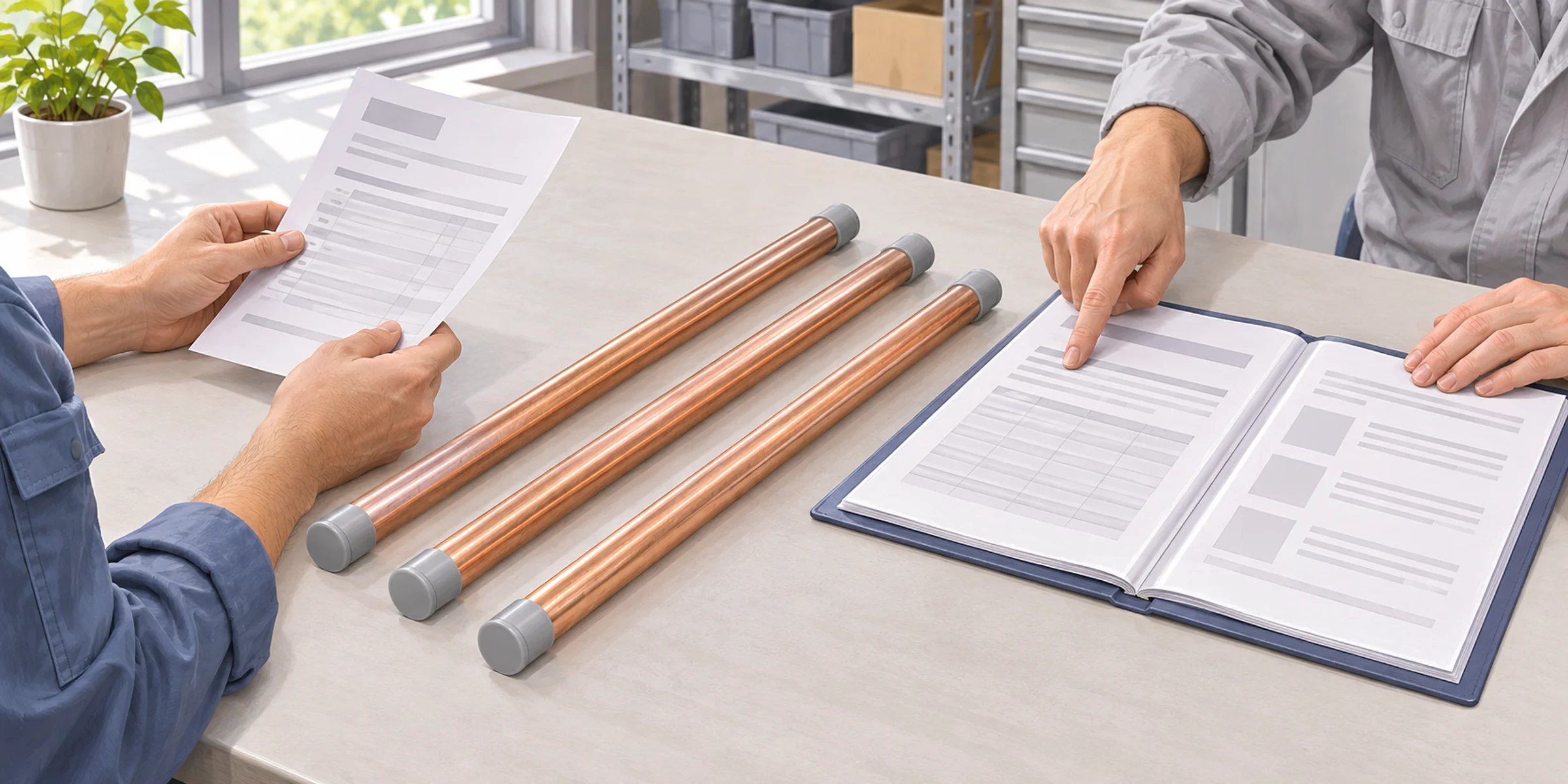
Resolve suitability before installation
The alternative must also satisfy the refrigerant compatibility, design pressure and temperature, dimensions, connections and project documentation. If one requirement remains unsupported, hold the review substitution. A successful fit-up or one passing field test cannot answer every one of those questions.
Consider this hypothetical substitution request: a contractor offers unused Type L stock for a project that specifies B280 ACR tube. The OD and wall match the approved schedule, but the offer contains only a water-tube declaration and no refrigeration-preparation evidence. Those matching dimensions support further review; they do not close the material-specification gap. The next step is to obtain the missing evidence or retain the approved tube.
This example makes no claim that all Type L tube is unsuitable. It shows why the decision concerns the documented item and its condition. If additional evidence establishes all applicable requirements, the project reviewer can assess the alternative on a complete basis.
Can ACR Copper Pipe Be Used in a Hydronic System?
Check the receiving system’s material specification
ACR preparation can be useful, but it does not automatically satisfy a water-system requirement for a particular product standard or tube type. Compare the proposed ACR tube with the hydronic schedule and identify any departures. A favorable feature in one category cannot compensate for an unresolved requirement in another.
For example, clean and protected tubing still needs the required dimensions, material condition and compatible connections. If the specification requires a particular certification or material declaration, obtain evidence covering that requirement. Avoid treating a refrigeration designation as a general approval for every water application.
Include water treatment and joint compatibility
Define the actual fluid, including any glycol type, concentration and treatment specified for the project. Check the proposed tube, valves, fittings and joint materials against that service. A connection approved for water alone should not be assumed suitable for every mixture or temperature range.
The reviewer also needs the hydronic design conditions and the proposed installation arrangement. The outcome may be approval, a request for more information or rejection of a specific deviation. It should identify the permitted application clearly so an approval for one circuit is not reused for a different service.
Pressure and Joining Evidence Decide the Assembly
Compare ratings at the required conditions
A pressure value has meaning only with its temperature, tube dimensions, material condition and rating basis. Two large numbers printed on different data sheets may describe different conditions. Compare each component with the project’s design envelope, including the conditions relevant to its intended operating and test procedures.
The tube is one part of that assembly. A fitting, valve, seal or joint can impose a more restrictive limit. Showing that the bare tube has adequate capacity does not establish the capacity of the complete connection. Keep the system review tied to the actual combination proposed.
Joining methods are not interchangeable labels
Soldering, brazing, flaring and mechanical joining have their own permitted products and procedures. Familiarity with one method on water pipe does not demonstrate its suitability for a refrigerant circuit. Conversely, a joint selected for refrigeration still needs to meet the hydronic project’s requirements when proposed there.
Identify the connection system and its approved tube dimensions and condition, then confirm the fluid and pressure-temperature scope. If the proposal changes both tube and joint, show both changes together. Reviewing them separately can conceal a mismatch at the point where they meet.
Conclusion
ACR and hydronic copper should be compared as specified products serving defined circuits. Shared copper chemistry or matching OD can support the comparison, but neither completes it. Substitution depends on documented service suitability, dimensions, preparation and connections, followed by approval of the actual proposed combination.
Frequently Asked Questions
Is hydronic copper pipe always Type L?
No. Hydronic describes a heating or cooling service using a circulating water-based fluid. The project specifies the tube type, material condition and connections. Type L may be selected, but the word hydronic alone does not establish that requirement or its permitted alternatives.
Is ACR copper the same as Type L copper?
No. ACR identifies a refrigeration-tube application and specification, while Type L identifies a copper water-tube wall series. Some dimensions or other properties may overlap. Compare the actual product documentation rather than assuming that either label proves compliance with the other.
Can I use leftover heating pipe for a refrigerant line?
Only after its identity, condition and compliance with the refrigerant project’s requirements are established and the alternative is approved. Unknown internal contamination or missing preparation records remain unresolved even when dimensions match. Do not treat leftover stock as approved material by appearance alone.
Does a higher tube pressure rating make substitution acceptable?
No. The rating must apply at the required conditions and to the actual tube. The connections and other components need their own suitability evidence. Dimensions, preparation, fluid compatibility and the specified product standard can still prevent approval despite an adequate tube rating.
Can the same copper fitting serve both circuits?
Possibly, when its documentation explicitly covers the proposed tube and both services under the relevant conditions. Check the fitting, joint materials and installation method as a combination. A matching socket diameter or familiar appearance does not establish approval for another fluid or operating envelope.