
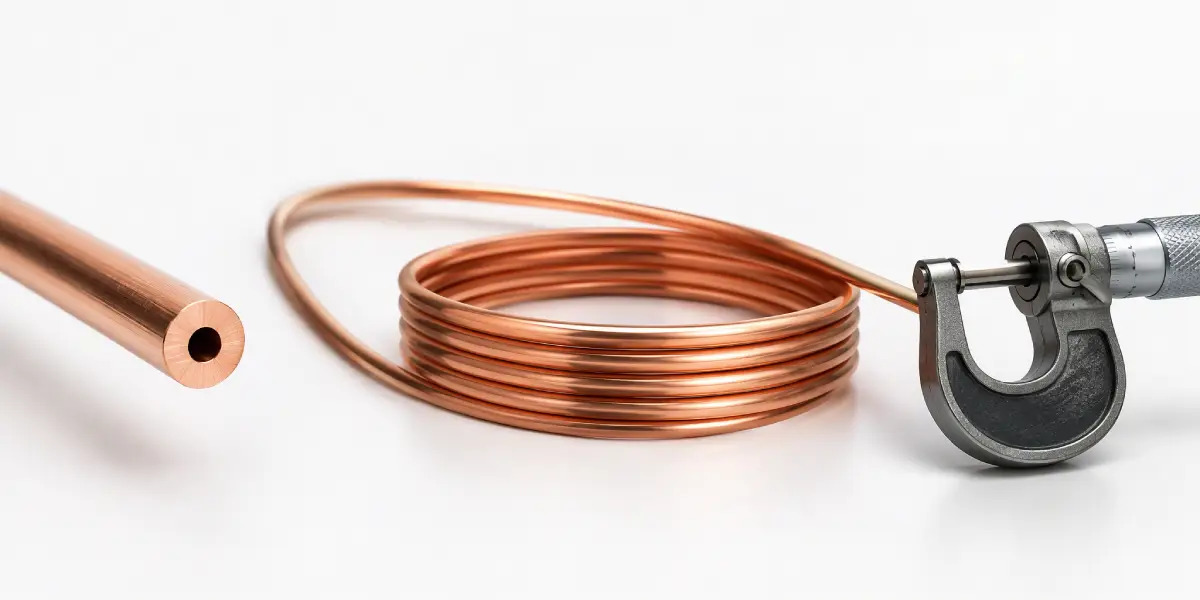
A capillary copper tube is easy to describe visually: a small copper tube with a narrow internal passage. Its engineering identity is less obvious. The same-looking tube might be specified as a refrigerant restriction, a fluid passage, or a component in a custom assembly. The application determines which dimensions and tests matter.
For refrigeration, the tube’s narrow bore and length form a fixed restriction between the high- and low-pressure sides. Selecting it connects three separate questions: what size the tube actually is, how it behaves in the system, and how consistently that behavior can be reproduced in production.
Executive Summary
- Identify the function before treating the word “capillary” as a complete specification.
- Inside diameter, outside diameter, and length describe different aspects of the component.
- Refrigeration selection is a system-matching task; a dimensional chart cannot supply a universal capacity rating.
- Manufacturing acceptance needs defined measurements and test conditions, particularly when bore consistency is critical.
- Preserve the tested component definition when transferring a prototype into repeat production.
What Makes a Refrigeration Capillary Different?
A fixed passage rather than a feedback valve
A conventional capillary restrictor has no actuator that changes its opening in response to an outlet sensor. Its flow behavior depends on its geometry and operating conditions. A thermostatic expansion valve, by contrast, adjusts its opening through a feedback mechanism responding to evaporator outlet conditions.
That difference matters when choosing an expansion arrangement. A capillary can be part of a successfully matched system, but it does not provide the same active control function as a modulating valve. Evaluate whether the equipment’s load range and operating strategy suit the selected arrangement.
Do not infer the application from small diameter alone
A small tube used to convey a sensing pressure is not automatically a qualified refrigeration metering device. Likewise, a tube sold by OD for mechanical fit may lack the bore-control evidence required for a flow-critical application. State the function and acceptance requirements together.
The first project document should answer a simple question: is the primary requirement a predictable restriction, a passage with suitable mechanical fit, or another defined function? That answer determines the work that follows.
Three Questions That Organize Tube Selection
1. What does the size callout actually mean?
ID is the internal diameter of the passage. OD is the external diameter used for fit and handling. Wall thickness connects the two for an ideal concentric circular section, but a nominal size does not describe all dimensional variation. Length must also be identified independently.
A decimal inch ID can resemble a metric number or a product code if its units are omitted. Preserve the original units when transferring a catalogue value into a drawing, and specify the controlling dimension and tolerance. The capillary tube size chart provides a sourced dimensional example and explains conversion and rounding. It deliberately does not assign refrigeration capacity to a diameter alone.
2. How is the tube matched to refrigeration duty?
A refrigeration selection needs representative system conditions, not only a compressor horsepower label. The refrigerant, operating temperatures, and capacity basis belong in the selection record. The tube also interacts with its installed thermal arrangement, including any heat exchange with the suction line.
Secop presents its CapSel result as a starting value for optimization. That is an important boundary: a software output can identify a candidate, while the assembled equipment must establish acceptable operation. The refrigeration capillary matching guide develops this into a test plan spanning relevant load and ambient conditions. It also separates component selection from fault diagnosis.
3. Can production reproduce the qualified component?
A successful prototype does not automatically define an inspectable production tube. Record its material condition, dimensions, finished length, and preparation. Where flow is a critical acceptance characteristic, define the test medium, pressure conditions, temperature basis, and measurement method.
Dimensional and flow checks answer different questions. A measurement at a cut end may not describe the full length; a gas-flow result does not itself prove operation with refrigerant in the appliance. The small-diameter tube quality guide explains how geometry, preparation, and test records can be combined without treating one check as proof of everything.
Build a Specification Around Function
Separate design values from acceptance limits
A nominal bore is a design reference. Acceptance requires an agreed range, method, and sampling basis. Do not turn the number of decimal places printed in a catalogue into an assumed manufacturing tolerance. Where limits have not been supplied, identify them as unresolved requirements.
The same distinction applies to length. A development report should make clear whether a dimension describes the supplied coil length, a cut blank or the finished installed component. This avoids transferring a prototype result to a production piece whose effective geometry differs.
Preserve the assembly definition
Routing, end preparation, and the thermal relationship to adjacent tubing are part of the qualified arrangement. Keep a drawing revision and a component identifier with the test record. If one of those features changes, assess whether the earlier system result remains applicable.
This is particularly useful when a purchasing substitution seems minor. A tube that fits the same connection may still differ in bore or condition. A substitution review should identify the functional consequences before the part number is released.
Move From Sample to Repeat Supply
| Project stage | Main question | Useful output |
|---|---|---|
| Define the application | What must the tube do? | Functional brief and operating boundaries |
| Select a candidate | Which geometry is worth testing? | Traceable selection inputs and assumptions |
| Test the assembly | Does it work across the required conditions? | Recorded system results and accepted drawing |
| Qualify supply | Can the accepted definition be reproduced? | Inspection method and production acceptance record |
The sequence prevents two common gaps. One is buying a catalogue size before identifying the system requirement. The other is approving a working prototype without capturing enough detail to reproduce it.
For a Nexnice inquiry, indicate the stage you have reached. An early request may need a candidate tube discussion; a production request should identify the approved drawing and the evidence required with supply. Neither should imply unverified supplier capabilities.
Know What a Supplier Record Can Establish
A dimensional report can document specified measurements. A material record can identify the supplied material. A defined flow test can compare a relevant characteristic under controlled conditions. None of these alone certifies the complete refrigeration appliance’s efficiency or operating envelope.
Keep the component and system approvals connected but distinct. This makes later troubleshooting more efficient: investigators can determine whether a change occurred in the tube, its assembly or the equipment’s operating conditions rather than assuming every performance difference originates in nominal size.
Conclusion
Capillary copper tube selection works best as a chain of evidence: a defined function, an unambiguous size, a validated application and a reproducible product. The size chart, refrigeration guide and manufacturing guide address different parts of that chain. Together they turn a small component into a specification that can be understood and maintained.
Frequently Asked Questions
Does “capillary” specify a universal copper tube size?
No. The term describes a narrow-passage tube used in a particular application, but it does not provide complete dimensions or acceptance limits. Identify the inside diameter, outside diameter, length, material condition and required function before comparing products.
Is a capillary tube a pressure-regulating valve?
A conventional refrigeration capillary is a fixed restriction without an actively adjusted opening. Its behavior changes with operating conditions, but that is different from feedback regulation. Select and validate it within the intended system rather than assigning it a valve’s control function.
Can a product code replace a dimensional drawing?
Only if the referenced product definition unambiguously provides every required attribute and remains controlled. A code by itself may identify a catalogue item without stating its acceptance limits. Retain the applicable drawing or specification revision with the approved component record.
What is the difference between component and system approval?
Component approval establishes conformity with the tube’s defined requirements. System approval establishes performance in the assembled equipment under specified operating conditions. Both are useful, but neither automatically replaces the other when geometry, assembly or operating conditions change.
Which information should come first in an inquiry?
Start with the tube’s function and the current development stage. Then provide known dimensions, operating conditions and acceptance requirements. This distinguishes an early selection discussion from a production quotation against an already qualified drawing and avoids assumptions about missing details.