
An ACR copper pipe submittal should let the reviewer connect each project requirement to an identifiable product and a specific piece of evidence. A catalog with many suitable-looking options leaves that work unfinished if nobody marks the option being offered.
The six checks below organize the review around the actual tube, its intended service and the records available at the current project stage. They also distinguish information needed for product approval from batch documents that may become available only after manufacture. The project’s submittal requirements determine what must be provided and when.
Executive Summary
- Identify the offered product and the circuit where it will be used.
- Match the specified standard, edition, alloy and temper.
- Mark the actual OD, wall and supplied length for each item.
- Tie pressure-temperature and joining evidence to the proposed combination.
- Separate product data from shipment-specific inspection records, with clear deadlines for missing evidence.
Check 1: Product Identity and Intended Use
Select the item within the product family
Begin with the manufacturer, product name or code, supplied form and applicable document revision. A refrigeration copper tube technical data sheet may describe several sizes, tempers or product families. Highlight the entries included in the proposal so the reviewer does not have to infer the selection.
The ACR copper tube guide provides the broader product context. A submittal goes further: it connects a defined item to the material schedule. Use the same item reference on the marked data sheet, compliance response and drawing or schedule wherever possible.
Name the receiving circuit
State the intended refrigerant service and identify the project system or line schedule. If the same submission contains water-system tubing or other copper products, distinguish the items clearly. A general statement that a supplier serves HVAC does not establish which product belongs in a particular refrigerant circuit.
Record any departure from the specified product at this stage. An alternative should be visible to the reviewer, together with the requirement it changes. Hiding a substitution inside an unmarked catalog makes it difficult to determine what the eventual approval covers.
Check 2: Standard and Edition
Match the exact reference in the project
Compare the standard designation and edition specified by the project with the offered product’s declaration. For an ASTM-based ACR project, B280 may be the relevant product standard, but the actual specification controls. The copper tube standards guide explains the wider distinctions between standards.
A current edition on a supplier document and an earlier edition in the contract create a question to resolve. Do not silently replace the contract reference or assume that the difference is harmless. Ask for the project’s accepted basis and document any approved clarification or equivalence review.
Identify what each certificate covers
A product declaration, a test report and a management-system certificate answer different questions. Check the issuing entity, product scope, referenced requirement and any applicable validity information. A certificate describing an organization’s management system does not establish every dimensional or performance claim in a tube schedule.
Where the specification requires third-party certification, verify the relevant product, size range and conditions against that certification. Where it does not, avoid adding unrelated certificates merely to increase the packet’s length. The useful document is the one that supports an actual requirement.
Check 3: Alloy and Temper
Keep the material designation explicit
Record the specified copper alloy and the offered designation. If two naming systems are used, provide a reliable mapping rather than treating similar names as proof of equivalence. “Copper” is too broad when the project requires an identified material.
A general catalog composition table can describe the product family. A batch chemistry record, when required, describes an identified production lot. Keep their roles separate. If batch material has not yet been produced, state when the traceable record will be submitted instead of presenting a typical value as a measured lot result.
Match the documented material condition
Show the offered temper and confirm that it agrees with the specified forming and connection requirements. Coil or straight length describes supply form; the document should still identify the material condition required by the project.
Check consistency across the packet. If the offer says annealed while a calculation assumes hard-drawn material, the reviewer needs a correction or explanation before relying on that calculation. The heat effects of the proposed joining process also belong in the applicable service-rating review, rather than being lost between separate documents.
Check 4: Outside Diameter, Wall and Length
Mark the proposed dimensional row
List OD, wall thickness and supplied length with units. Identify the dimensional series and whether a wall requirement is nominal, minimum or subject to stated tolerances. A row marked only by a fractional size leaves too much room for confusion between naming systems.
The ACR size and weight chart separates selected straight-tube and coil schedules. Use it for dimensional context; the submittal must still identify the specific row offered for the project. A calculated catalog weight is not evidence of measured dimensional conformity.
Reconcile every scheduled item
Compare the marked data sheet with the material schedule line by line. Mixed units, omitted walls and different supplied lengths should be resolved in one controlled schedule. Include quantity only where the project requires it for this review; a quantity total cannot replace item-level identification.
If the proposed length changes the installation arrangement, flag that consequence for the responsible reviewer. A shorter supplied length may require additional joints even when OD and wall match. The submittal should make such a change visible rather than leaving it to be discovered during installation.
Check 5: Pressure-Temperature and Joining Evidence
Keep the rating conditions attached
Locate evidence applicable to the offered dimensions, material condition and required service conditions. Preserve the associated temperature and any limitations beside the pressure claim. A maximum value extracted from a wider table is unhelpful when its conditions or covered sizes have disappeared.
Distinguish design ratings, production tests and project field tests. They serve different purposes and should not be substituted for each other in the compliance response. If a calculation is required, identify its inputs, method and responsible author so the reviewer can determine whether it applies to the proposed tube.
Review the connection with the tube
Include the proposed joining method and the evidence required for its compatibility with the tube, refrigerant and operating envelope. Fittings, valves, seals and joint materials can have limits of their own. Tube data alone cannot establish the suitability of the full assembly.
Cross-reference the relevant connection document instead of pasting a disconnected rating into the tube sheet. If joining is covered by another submittal, identify that package and its review status. This lets the reviewer see whether a missing connection approval prevents the tube proposal from being released for its intended use.
Check 6: Cleanliness, Closures and Batch Records
Document the supplied internal condition
Identify the required internal preparation and end protection, then locate the supplier’s statement covering the proposed product. Packaging photographs can illustrate closures, but they cannot establish internal residue or dryness by themselves. Use the evidence required by the project for those claims.
The submission should also identify any agreed handling instructions needed to preserve the delivered condition. Detailed warehouse practice belongs in the site procedure; the product review needs a clear connection between the specified condition and what the supplier commits to deliver.
Link records to the material they represent
For required inspection or test records, identify the report, sample or batch reference and the product it covers. Check the test method, acceptance criteria and reported result where applicable. “Tested” without that context gives the reviewer little basis for a decision.
Separate documents available at approval from those due before shipment, delivery or installation. The project’s procedure determines whether a later submission is allowed. A proposed deadline does not waive a requirement, and a sample report should remain visibly identified as a sample until the required lot record is available.
Build a Requirement-to-Evidence Review Table
Use the following worksheet structure for each proposed item or clearly defined group. The evidence column describes what to enter; it contains no actual certificate, page number or batch result. Add project-specific criteria and the responsible person for each open action.
| Project requirement | Evidence page or batch reference to enter | Missing item or review action |
|---|---|---|
| Product identity and intended circuit | Marked product sheet, revision and schedule item | Resolve an unselected option or unclear service |
| Standard and edition | Applicable declaration and exact scope reference | Resolve a different edition or unsupported compliance claim |
| Alloy and temper | Material designation and condition; lot record when due | Correct conflicting material descriptions |
| OD, wall and supplied length | Selected dimensional row and controlling units | Complete omitted dimensions or explain a deviation |
| Pressure-temperature and connection suitability | Applicable rating or calculation and linked joint package | Supply conditions, size coverage or connection evidence |
| Internal preparation, closures and required tests | Product statement plus traceable batch records at the required stage | Identify the missing record, responsible party and release condition |
Write an actionable review comment
A useful comment names the affected requirement and the evidence still needed. “Please clarify wall thickness” is less effective than identifying the schedule item, the conflicting values and the document that needs revision. The response can then be checked against a precise request.
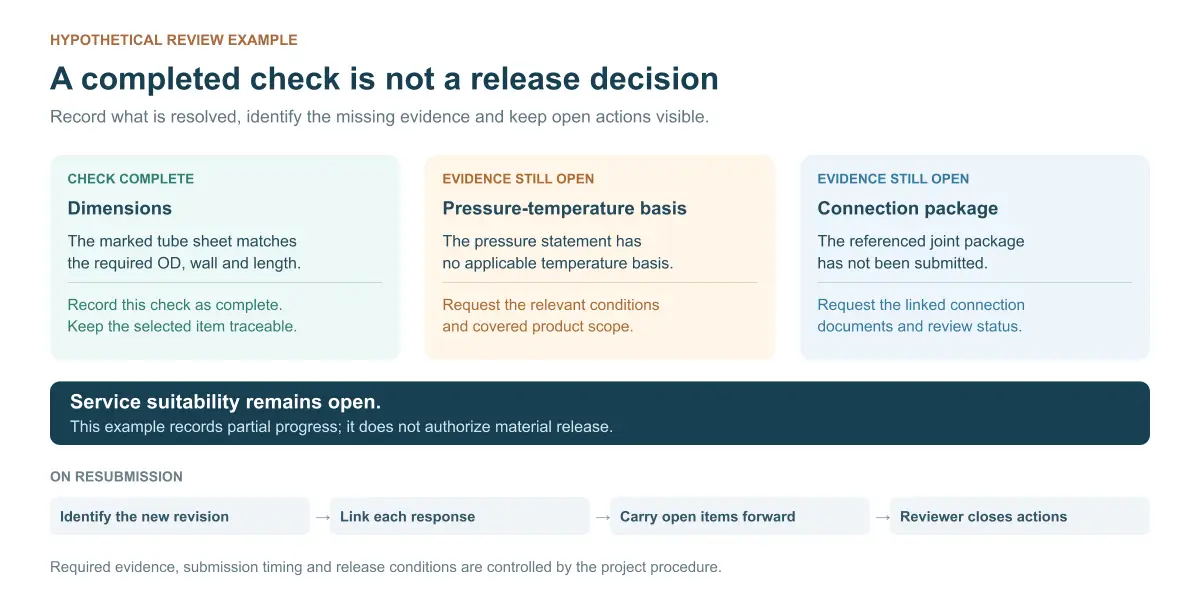
For this hypothetical review, assume the marked tube sheet matches the required dimensions, but its pressure statement has no temperature basis and the referenced joint packet is absent. The dimensional check can be recorded as complete. Service suitability remains open pending the applicable pressure-temperature evidence and connection submission. The example demonstrates partial review progress; it does not authorize material release.
Preserve the decision through revisions
Assign a revision identifier to the resubmitted packet and show which comments it answers. Carry unresolved items forward until the responsible reviewer closes them. A revised cover sheet alone does not demonstrate that a technical issue has been corrected.
Retain the accepted product identity and limitations with the final decision. If the supplier later proposes a different tube, size or connection, compare that change with the approved basis. Approval of one documented selection should remain traceable to that selection throughout procurement and delivery.
Conclusion
A useful ACR copper pipe submittal makes six areas reviewable: identity, standards, material condition, dimensions, service and joining evidence, and protected supply with traceable records. Clear references and specific open actions help the reviewer reach a defined decision without mistaking a broad catalog or sample report for complete project evidence.
Frequently Asked Questions
Is a technical data sheet enough for an ACR submittal?
Only if it satisfies the project’s required scope. A data sheet may identify product options without selecting the offered item or providing required connection and batch evidence. Mark the applicable entries and add the documents needed to resolve each specified requirement.
Must batch certificates be available before product approval?
That depends on the project’s submission stages. Product information may be reviewed before the ordered batch exists, while traceable records are due later. State the required timing and release conditions explicitly; never present a sample certificate as evidence for an unproduced or unidentified batch.
What should a resubmitted package identify?
Identify the new document revision, the review comments addressed and the pages containing the responses. Carry unresolved items forward visibly. If the product selection changes, show that change explicitly so the reviewer can assess the revised proposal against the previously reviewed basis.
Does a factory test prove the installed pressure rating?
No. A factory test reports an outcome under its defined method and conditions. Installed suitability also depends on the design basis, dimensions, material condition and connections. Review the applicable rating evidence and required field procedures separately from the production test record.
Should every missing document stop all review work?
Not necessarily. Record completed checks and identify the decisions that the missing evidence prevents. The project procedure determines whether conditional review or later submission is allowed. Keep unresolved requirements and release restrictions visible until the responsible reviewer accepts the required evidence.