
A copper tube size chart is useful only when its columns describe the product you intend to buy. One table may list actual outside diameters for ACR tubes. Another may start with nominal water-tube sizes. A third may include calculated bores for selected walls.
This copper tube size chart guide helps you read those distinctions without combining incompatible rows. The conversion table identifies dimensions; the worked examples explain bore calculations and tolerance interpretation. None of the tables assigns a pipe size to a particular air conditioner.
We focus on the checks that help buyers move from a catalog entry to a clear drawing or purchase description. The broader installation and procurement discussion can be linked from the supporting sections below.
Executive Summary
- Read the product family and sizing convention before using a chart row.
- Keep exact unit conversion separate from manufacturing tolerances.
- Calculate ideal ID from OD and wall, then review actual dimensional limits.
- Confirm whether wall values are nominal, minimum, or explicitly toleranced.
- Use the approved equipment schedule for system selection after identifying dimensions.
Copper Tube Outside Diameter Chart
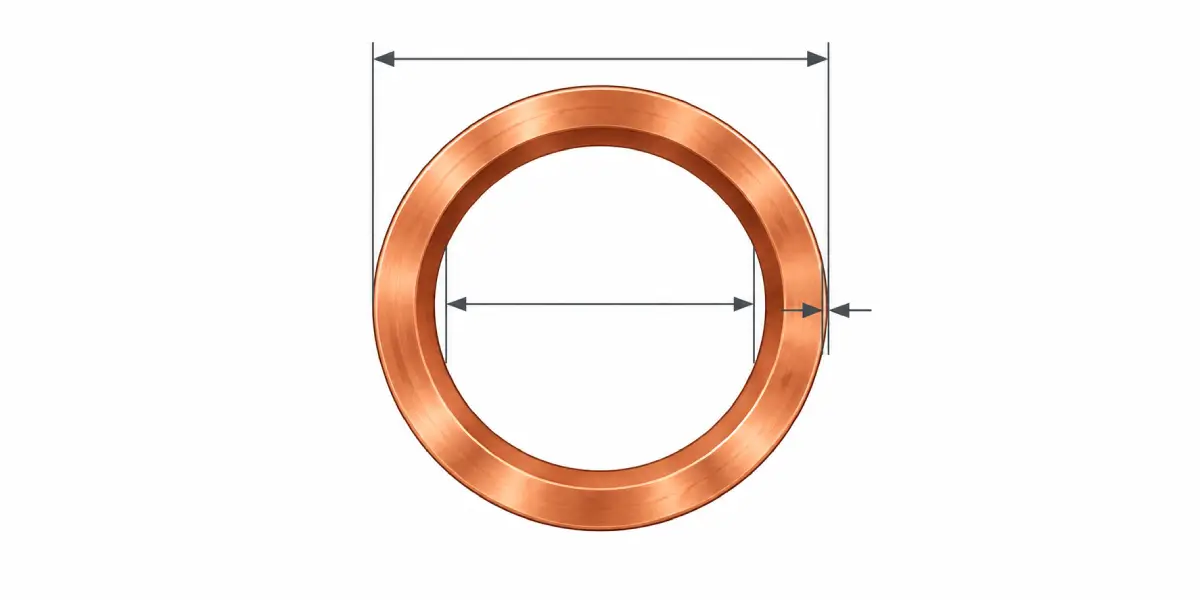
Inch OD Converted to Millimeters
The table converts selected outside-diameter designations using exactly 25.4 millimeters per inch. Values in the millimeter column are mathematical conversions. They are not a list of approved wall thicknesses or a guarantee that every listed size is available from a particular supplier.
| OD designation | Decimal OD, inch | Exact OD conversion, mm |
|---|---|---|
| 1/8 inch | 0.125 | 3.175 |
| 1/4 inch | 0.250 | 6.350 |
| 3/8 inch | 0.375 | 9.525 |
| 1/2 inch | 0.500 | 12.700 |
| 5/8 inch | 0.625 | 15.875 |
| 3/4 inch | 0.750 | 19.050 |
| 7/8 inch | 0.875 | 22.225 |
| 1 1/8 inch | 1.125 | 28.575 |
Retain the original designation when copying a row into a specification. A converted number is useful for communication, but it should not create a second, conflicting acceptance requirement. We recommend identifying the controlling units in the drawing and describing the other units as a reference conversion.
Rounded Catalog Numbers Need Interpretation
Commercial descriptions may show 9.52 mm, 9.53 mm, or a shorter 9.5 mm beside a 3/8-inch designation. Check the original dimensional series and product limits before interpreting those labels as different manufactured sizes.
Rounding is a display choice. A tolerance defines an accepted range. Confusing the two can lead an inspector to reject material against a precision that the catalog never intended to specify.
Ask the supplier to confirm the governing OD and its permitted limits. For a metric-dimensioned component, use its drawing requirement directly. A familiar inch conversion does not automatically make 3/8-inch tubing interchangeable with separately specified 10 mm tubing. The fitting or component designer must approve the actual dimensions used in that connection.
Nominal Copper Pipe Sizes Versus Actual OD
Identify Which Size System Applies
North American copper water-tube nominal sizes differ from the physical OD. ACR tube descriptions use actual OD designations. That distinction is essential when comparing catalog entries that use the same fractional label.
| Label being compared | Physical OD, inch | Physical OD, mm |
|---|---|---|
| 1/2-inch OD tube | 0.500 | 12.700 |
| Nominal 1/2-inch water tube | 0.625 | 15.875 |
| 3/4-inch OD tube | 0.750 | 19.050 |
| Nominal 3/4-inch water tube | 0.875 | 22.225 |
This comparison identifies physical dimensions only. It does not approve substitution between the water tube and the refrigerant tube. Wall, material condition, and application requirements remain separate. Use the product standard and drawing to establish the complete item rather than assuming that matching OD makes the products equivalent.
Read Fitting Descriptions With the Tube
A fitting catalog may describe a connection by the tube system it is intended to accept. Do not compare only the fractional words on the two package labels. Find the fitting’s approved tube OD and product requirements.
For a mixed inventory, record that connection dimension with the stock item. The buyer who ordered the tube may understand the naming convention, while the warehouse employee selecting a fitting may see only an abbreviated description.
We would ask for a connection schedule when the order includes several product families. Identify the intended tube and fitting together, then preserve those references in the bill of materials. This turns a potentially ambiguous “half-inch connection” into a defined assembly that purchasing and receiving can both recognize.
How to Calculate Copper Tube ID
Use the Wall Twice
For an ideal round tube with a uniform wall, the inside diameter equals OD minus twice the wall thickness. The subtraction accounts for metal on both sides of the bore. Keep every value in the same unit before calculating.
The next table uses deliberately hypothetical wall values to demonstrate the calculation. These are teaching examples, not a standard wall schedule or proposed HVAC specifications.
| Example OD, mm | Assumed wall, mm | Calculated ID, mm | Calculation |
|---|---|---|---|
| 6.350 | 0.70 | 4.950 | 6.350 − 1.40 |
| 9.525 | 0.80 | 7.925 | 9.525 − 1.60 |
| 12.700 | 0.90 | 10.900 | 12.700 − 1.80 |
| 15.875 | 1.00 | 13.875 | 15.875 − 2.00 |
When a catalog provides OD and wall but no ID, this relationship explains the ideal bore. Actual acceptance still follows the specified dimensional limits and the agreed measurement method.
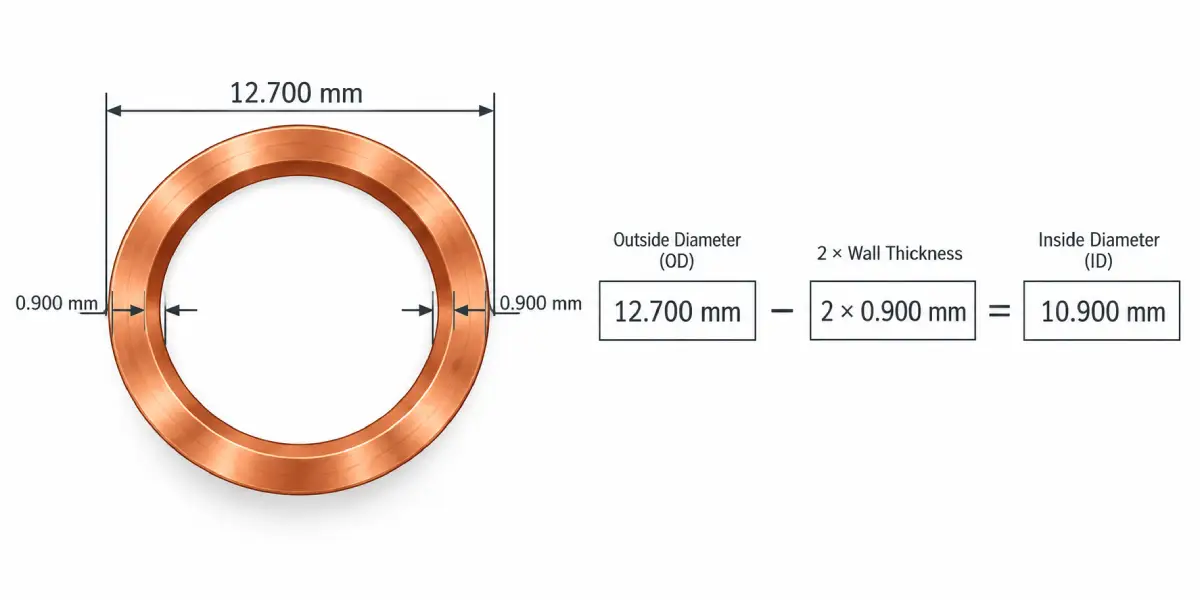
Bore Area Is a Geometric Quantity
For a circular bore, cross-sectional area equals π multiplied by ID squared, divided by four. For example, an ideal 10.90 mm bore has an area of approximately 93.31 mm². That result follows from the hypothetical dimensions above.
The calculation does not establish refrigerant flow, pressure loss, or cooling capacity. Those require the relevant operating conditions and system design. Avoid turning an area ratio into a claimed efficiency improvement.
If an OEM drawing controls the bore for a component, ask which dimensional requirement takes priority and how it will be inspected. Specifying OD, ID, and wall independently without reviewing their relationship can create incompatible limits. We recommend resolving that issue before requesting samples, since it affects both manufacture and the interpretation of the inspection result.
Copper Tube Wall Thickness and Tolerances
Nominal Wall Is Not Automatically Minimum Wall
A chart may list a nominal wall value, while the product standard defines permitted variation. An order that requires a minimum measured wall says something different. The buyer should make that distinction explicit.
For K, L, and M water-tube series, wall values depend on size as well as type. Our copper tube grades comparison uses a published manufacturer example to show how the same OD can have different walls. Do not apply one row’s wall value to every size in the series.
When reviewing an alternative offer, ask whether the proposed value follows the same acceptance convention. A quoted nominal wall and a specified minimum wall cannot be compared as though they were identical instructions. Keep the controlling standard and any additional drawing limits visible in the commercial review.
Review Dimensional Limits Together
Consider another hypothetical drawing: OD 10.00 ± 0.05 mm and wall 1.00 ± 0.05 mm. Using independent extreme values, the ideal calculated ID range would be 7.85 to 8.15 mm. This is a simple limit calculation, not a published copper-tube tolerance.
The example shows why independently toleranced dimensions need review as a set. A separate requirement for ID to remain within a tighter range may need additional control or a different specification strategy.
Actual tube geometry and standard-specific measurement rules also matter. We would ask the manufacturer and inspection team to agree on how OD, wall, and roundness are assessed. A spreadsheet calculation helps find a possible conflict, but it cannot establish conformity without the product’s defined acceptance requirements and measured results.
How to Verify Copper Tube Dimensions at Receiving
Measure the Feature the Chart Describes
Match the measurement to the named feature. OD refers to the bare tube exterior, while the finished insulated diameter includes the covering. A wall measurement requires suitable access and an appropriate instrument. Measuring the package or the insulation cannot verify copper OD.
- Identify the sample, item code, and controlling specification.
- Use an instrument suitable for the required measurement and tolerance.
- Record the location and observed readings before judging acceptance.
- Compare the result with the agreed limits and measurement method.
For soft or visibly distorted material, a single reading may not describe the full geometry. Follow the agreed procedure for checking different positions and directions. Keep a damaged-end observation separate from representative product measurements so the inspection report explains exactly what was found.
Separate Identification From Acceptance
A quick caliper check can help identify a tube size. A formal acceptance check may require a defined instrument, sampling method, and record. Decide which task the team is performing so a rough screening measurement does not become unsupported certification.
An apparent disagreement can arise from units, naming, or measurement location. Review those first, then examine the material against the actual limits. If the order describes nominal water tube while the receiving checklist assumes ACR OD, the paperwork itself needs correction.
For an inquiry about our copper tube products, send the drawing or standard reference used for acceptance. We can discuss a clearer product description when the chart row alone leaves uncertainty. The final order should let another inspector repeat the same check and understand the result.
Turning a Copper Tube Chart Into an Order
Add the Missing Product Requirements
A dimension row is only part of an RFQ. State the service and the rest of the product definition before treating the table as an order schedule. This prevents suppliers from filling the missing fields with different assumptions.
- Specify the product standard and edition.
- State OD, wall requirement and the controlling dimensional units.
- Add alloy where required, temper and supplied form.
- Define lengths, quantities, end protection and inspection evidence.
For Nexnice quotations, include both the selected chart row and the intended application. Mark any unapproved value as preliminary. Once the technical team confirms the requirement, preserve that controlled description with the order rather than replacing it with a shortened invoice label.
Keep System Selection Outside the Conversion Table
The table can identify a size, but the equipment instructions must establish whether that size is permitted on a particular route. Use our guide to choosing copper tube size for HVAC when turning equipment requirements into a segment-by-segment pipe schedule.
- Confirm the exact equipment combination and applicable instructions.
- Check the approved route, branches and vertical separation.
- Assign the specified dimensions to each pipe segment.
- Review deviations before changing the purchase schedule.
For repeat orders, retain the original drawing revision and the reason each item was selected. A warehouse substitution based on a nearby chart row may change the connection or bore. The closer two sizes look in a table, the more useful a clearly controlled item description becomes.
For catalog data entered into a purchasing system, preserve the original size as text as well as any numeric conversion. A fraction such as 1/4 should not be interpreted as a date, and a unit should never be dropped from a dimensional field. Review imported rows against the source before creating stock items. This small data check is particularly useful when an overseas supplier and a local warehouse use different display formats for the same approved specification.
Read the Columns Before Choosing the Row
Start with the sizing convention, then identify OD, wall and any calculated ID. Keep conversion, tolerance and system selection as separate decisions. A well-read chart should help you write an unambiguous specification, rather than create a second set of assumptions for the supplier to interpret.
Frequently Asked Questions
Is a copper tube size chart based on OD?
It depends on the chart’s product family. ACR charts use actual outside-diameter designations, while North American water-tube charts may begin with nominal sizes. Read the heading and standard reference before using the row to select a fitting or write an order.
How do I calculate the copper tube’s inside diameter?
Subtract twice the wall thickness from the outside diameter using consistent units. This gives the ideal ID for a round tube with a uniform wall. Actual acceptance also needs the specified dimensional limits and measurement rules, rather than nominal arithmetic alone.
Why show both 9.52 and 9.53 mm?
Both can appear as commercial representations of the familiar 3/8-inch series, whose exact conversion is 9.525 mm. Check the original designation and governing limits. The displayed rounding does not, by itself, define a different tube or manufacturing tolerance.
Does one OD always have the same wall thickness?
No. Tubes with the same outside diameter can have different wall requirements and therefore different bores. Identify the product standard, tube type or drawing specification before using a wall value from a chart to assess the offered material.
Can a size chart select my refrigeration line?
No. A dimensional chart identifies geometry, while line selection depends on the approved equipment and route requirements. Use the manufacturer’s instructions and project schedule because connection sizes, branches, length and elevation may affect which dimensions belong on each segment.
Request a Quote
Send Nexnice the required OD, wall limits, material condition, and quantities, together with the drawing or standard reference. Request a dimension-specific copper tube quotation to clarify the product behind your selected chart row before placing the order.