
A refrigerant line can have the correct outside diameter and still be the wrong product to order. Internal condition, wall specification, material condition, and protected delivery all need attention. A short description such as “copper pipe for AC” leaves too much for the supplier to interpret.
ACR copper tube means copper tube intended for air-conditioning and refrigeration applications. For field-service purchasing, the relevant product specification helps define what the tube must be when supplied. The equipment documentation determines how it may be used in the system.
We use this guide to connect those two decisions. It gives importers, distributors, and contractors a practical way to compare offers without treating a familiar abbreviation as complete proof of suitability.
Executive Summary
- Specify the tube standard and edition alongside dimensions and material condition.
- Confirm internal cleanliness, protected ends, and the agreed delivery condition.
- Separate field-service piping from tubing purchased for equipment manufacture.
- Review supplier evidence against the ordered product and batch.
- Let the approved equipment schedule govern pipe size and installation requirements.
What Makes Copper Tube an ACR Product?
The Application Needs a Full Specification
The letters ACR identify an application family. They do not provide a complete wall schedule, a refrigerant approval list or an installation procedure. Procurement still needs the dimensional and delivery requirements for the particular tube.
ASTM B280-23 covers seamless copper tube for air-conditioning and refrigeration field service. Its published scope is useful for identifying the product family, while the detailed order must supply the selected dimensions and any additional project requirements.
We would keep a supplier’s product description beside the technical schedule and compare them item by item. If the schedule requires one condition and the catalog offers several alternatives, ask which alternative the price includes. A general statement that the manufacturer makes ACR tubing is only the beginning of that review.
Copper Grade and Service Are Different Fields
An alloy designation identifies material chemistry; it does not replace a tube product specification. A drawing that lists C12200, for example, still needs dimensions, material condition and the required standard. Conversely, an application label does not tell the buyer every permitted alloy option.
ASTM B280’s public scope lists C10200, C12000, and C12200. Where a project specifically requires one, include that designation in the order rather than assuming the supplier will select it. Avoid treating one familiar grade name as the definition of every compliant ACR product.
The same distinction helps when discussing copper tube grades and wall types. Terms that describe alloy, wall series, temper, and application answer different questions. Combining them into one vague “grade” field creates an avoidable gap between engineering and purchasing.
ACR Copper Tube Standards and Supply Conditions
ASTM and EN References Need Context
For European-style specifications, EN 12735 distinguishes piping-system tube from tube used in equipment manufacture. The applicable part matters. Buyers should not accept a quotation that removes the part number from an approved specification.
| Reference | Procurement context | Information still needed |
|---|---|---|
| ASTM B280-23 | Field-service ACR tube | Selected dimensions and delivery requirements |
| BS EN 12735-1:2020 | Refrigeration and AC piping | Alloy, size and material condition |
| BS EN 12735-2:2024 | Tubes for equipment manufacture | Product geometry and production requirements |
The references are not automatic substitutes for one another. If an importer needs compliance with more than one, request a clear statement for the exact product. Our copper tube standards comparison explains how to record editions and investigate an offer that proposes a different reference.
Coils and Straight Lengths Need Identification
Tube supplied in a coil and tube supplied in straight lengths can serve different handling plans. Specify the form that suits the job, then confirm temper separately. A package photograph should not become the basis for accepting material condition.
The public ASTM B280 abstract distinguishes annealed coiled lengths and hard-drawn straight lengths, including preparation and end closure. This gives buyers a useful reminder that a delivery condition involves more than a clean-looking exterior.
For an inquiry about ACR copper coils, state whether the supplied length must remain continuous and whether any end preparation is included. Ask how the order will identify each size after the outer shipping pallet is opened. Mixed project quantities need enough package-level information to reach the correct installation team.
Why Refrigeration Copper Tube Cleanliness Matters
Define the Inside Condition
An attractive copper surface tells a buyer little about the bore. Refrigerant-side requirements concern the specified internal condition, so a visual exterior check cannot replace the evidence or inspection method the order requires.
As a public manufacturer example, Wieland’s Cuprofrio literature describes a clean, dry inner surface and closed ends intended to preserve that condition during storage and transportation. The useful point is the connection between preparation and protection. It does not establish the cleanliness of another manufacturer’s shipment.
We recommend asking which records support the claimed condition and how they relate to the ordered material. Avoid writing an unsupported test limit into the RFQ from a general internet article. Use the controlling specification and agree any supplementary test requirement with the responsible technical team.
Protect the Condition During Handling
Opening every tube at receiving may undermine the condition the packaging was intended to preserve. Plan inspection so it gathers the necessary evidence with controlled handling. If sampling requires opening or cutting, agree how the inspected material will be identified and protected afterward.
- Check that the supplied end protection matches the agreed description.
- Identify packages with damaged closures or signs of water exposure.
- Keep opened samples separate from material awaiting installation.
- Record the disposition of any shipment affected by contamination concerns.
A missing cap is a reason to investigate the affected item; it does not, by itself, quantify contamination throughout the shipment. Avoid both extremes of automatically accepting it and inventing a test result. The response should follow the inspection agreement and the condition actually observed.
How to Read ACR Copper Tube Dimensions
Separate Outside Diameter From Wall
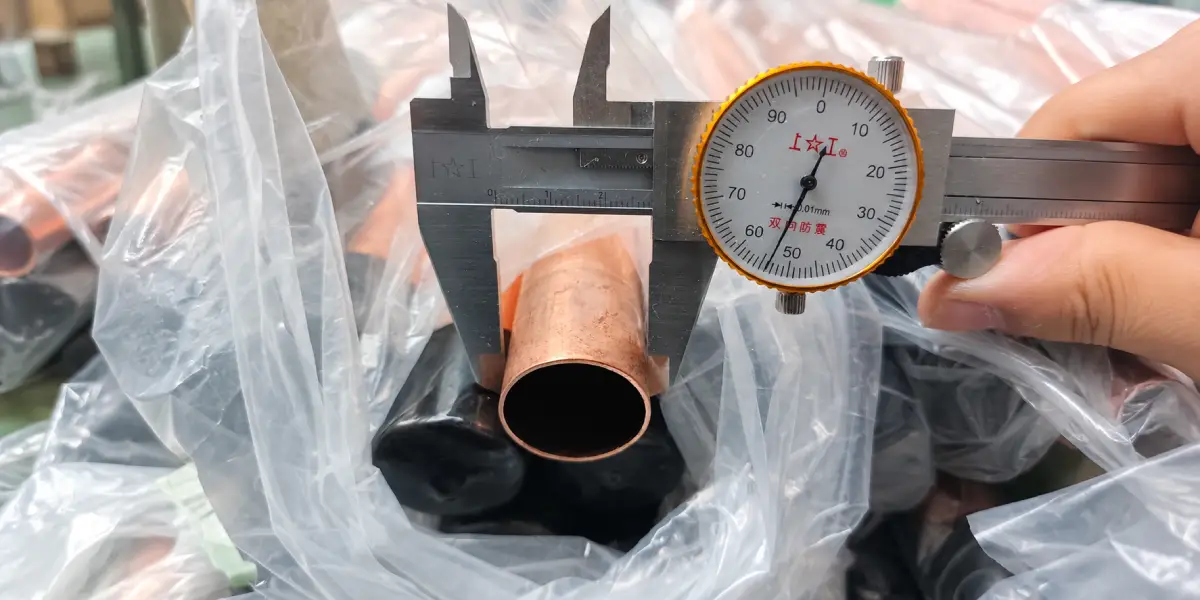
For the ACR field-service tube, the stated size is the actual outside-diameter designation. Wall thickness remains a separate requirement. This is why a size such as 3/8 inch cannot, on its own, define bore area or allowable service conditions.
Use the copper tube size chart when checking unit conversions, and preserve the governing units in the purchase description. A rounded millimeter label may be useful for identification while the original inch specification still controls acceptance.
Consider a hypothetical quotation listing 9.525 mm OD and a 0.80 mm wall. The ideal calculated bore is 7.925 mm. That arithmetic describes geometry only. It cannot verify the actual wall tolerance, cleanliness or suitability of a particular coil, and it should not be used as an equipment-sizing recommendation.
Read Every Leg of a Line Set
A paired line-set description needs both copper sizes. It also needs the supplied length, wall requirement for each leg and insulation specification. A pair label gives too little information to determine the complete assembly.
We would compare an offer for insulated copper pair coils against the equipment schedule one leg at a time. Then check whether the quoted insulation construction and finished dimensions suit the route and supports.
When fittings or prepared ends are included, confirm their details separately. A correctly sized copper pair can still arrive with an unsuitable connection arrangement. Include any required protective treatment of prepared ends and make clear whether the product is supplied ready for an approved connection process or needs additional work on site.
Choosing ACR Tube for HVAC and Refrigeration
Use the Approved Equipment Arrangement.
An ACR product designation does not choose the liquid and gas line diameters for a system. The model combination, piping route, and equipment instructions must supply that decision. Capacity alone is an incomplete selection basis.
For a replacement project, record which pipework will remain and which will be replaced. Ask the technical reviewer to confirm the permitted reuse conditions before purchasing only the missing sections. A matching connection size does not establish the condition of an existing line.
We find it more useful to request an approved pipe schedule than a rough description of the building. Give each route segment an identifier, size, and required supplied quantity. This lets the supplier quote a clear bill of materials and helps the installation team identify the intended use of each package.
Keep Heat-Exchanger Production Separate
Tube entering a manufacturing line may need controlled feeding, specific internal geometry, or a forming sequence that differs from field piping. The order should describe that process. A field-service product name cannot cover all of those requirements.
BSI’s public scope for EN 12735-2:2024 covers smooth or internally finned tubes for heat exchangers and internal connecting pipes in refrigeration and air-conditioning equipment manufacture. This distinction matters when an OEM compares a production coil with an installation coil.
Ask the production team which characteristics affect its equipment: supplied form, coil dimensions, temper, end condition, or internal profile. Record these before requesting samples. A trial should represent the production specification, since a successful run with one tube geometry does not demonstrate that a visually similar alternative will behave the same way.
How to Evaluate an ACR Copper Tube Supplier
Compare Evidence With the Quoted Item
Supplier documents become useful when their scope matches the offer. Check the manufacturer identity, product description, applicable specification, and traceability information. An unrelated certificate can look reassuring while answering none of the questions about the shipment.
| Document or record | What it can help establish | What it cannot establish alone |
|---|---|---|
| Product specification | Offered construction and requirements | Results for the delivered batch |
| Batch inspection record | Recorded checks on identified material | Every untested project condition |
| Management-system certificate | Scope of a certified management system | Tube dimensions or refrigerant approval |
| Approved sample record | The sample and process reviewed | Uncontrolled later substitutions |
ISO 9001 addresses a quality management system. Keep that evidence separate from dimensional records and product conformity. A purchase review works best when each document has a defined purpose and any missing evidence is requested directly.
Turn the RFQ Into a Receiving Plan
For Nexnice inquiries, send the technical description and the evidence you need together. That helps distinguish a request for a catalog item from a project specification with additional acceptance requirements.
- Identify the tube standard, edition, and required alloy where applicable.
- Define OD, wall, temper, supplied lengths, and quantities.
- State cleanliness, end protection, and packaging requirements.
- Include insulation or connection details if they form part of the order.
- Request the agreed inspection records and identify mandatory deviation reporting.
Before shipment, decide how receiving will confirm the essential points:
- Match item codes and quantities to the approved order.
- Inspect the agreed samples against the dimensional criteria.
- Review package condition and protected ends.
- Hold unresolved deviations until their disposition is documented.
If procurement, inspection, and installation use the same item description, an apparent discrepancy can be investigated quickly. Keep the drawing revision with the order so a later change does not leave different teams checking against different requirements.
For repeat purchases, retain the accepted specification rather than copying only the previous invoice description. A shortened commercial description can gradually lose requirements such as continuous length or end protection. Review changes in supplier, manufacturing location, or supplied construction against the approved technical package before treating the next delivery as equivalent.
Distributors can make this easier by maintaining separate item codes for technically different products. Two coils with the same OD may need different stock records when their walls, internal preparation or intended applications differ. Clear item control helps prevent a convenient warehouse substitute from becoming an undocumented technical change.
Buy ACR Tube as a Defined Product
Specify the dimensions, internal condition, delivery form, and supporting evidence together. Then connect that product to the approved equipment arrangement. This gives a supplier something concrete to quote and gives the receiving team a clear basis for acceptance when the material arrives.
Frequently Asked Questions
What does “ACR copper tube” mean?
ACR means air conditioning and refrigeration. The term identifies an application family, while the product specification defines the supplied tube requirements. Buyers still need to state dimensions, material condition, delivery details, and the equipment requirements relevant to the intended system.
Is ordinary copper pipe interchangeable with ACR tube?
Do not assume interchangeability. Similar outside dimensions do not establish the same internal condition, wall requirements or product conformity. Compare the proposed tube with the approved refrigerant-piping specification and obtain technical acceptance before replacing the specified product.
Must ACR tubing be supplied with protected ends?
Specify the required end protection and check it at receiving. Recognized ACR specifications include end-closure requirements because the supplied internal condition needs protection during handling. Damaged or missing protection should trigger the agreed inspection and disposition process for affected material.
Does ASTM B280 select my HVAC pipe size?
No. ASTM B280 defines a tube product specification; it does not choose pipe sizes for an individual installation. Use the equipment manufacturer’s instructions and approved piping schedule because the route, model combination, and system arrangement affect selection.
What should an ACR tube quotation include?
It should identify the product standard, dimensions, material condition, lengths, quantities, and delivery requirements. Include the requested inspection evidence and any insulation or connection details. These fields make competing offers comparable and provide a basis for checking the delivered material.
Request a Quote
Send Nexnice your ACR tube specification, quantities, destination, and required documentation. Attach the approved piping or component schedule where available. Request an ACR copper tube quotation to discuss the product details and identify any requirements that need clarification.