
An inquiry for “1/4 and 3/8 copper” may describe a pair of tubes, two stock items, or an incomplete line-set order. The numbers are familiar to HVAC buyers, but the missing details determine whether the supplier quotes what the installation team expects.
For actual-OD ACR descriptions, 1/4 copper tube has a designated outside diameter of 6.35 mm, while 3/8 copper tubing converts exactly to 9.525 mm. The 1/2- and 5/8-inch sizes follow the same outside-diameter convention. Wall, temper, length and insulation remain separate requirements.
We explain each size below, then show how to read paired descriptions and organize an order. These dimensions help identify products; the equipment instructions must establish the permitted combination for a specific installation.
Executive Summary
- Treat the four fractional ACR sizes as actual outside-diameter designations.
- Record the wall requirement separately for each tube.
- Read a paired size as two copper dimensions, not the complete insulated assembly.
- Confirm the equipment-approved combination before buying a line set.
- Specify supplied length, end preparation, and protection to complete the order.
Common HVAC Copper Tube Sizes in Millimeters
Read the Exact OD Conversion.
The table uses 25.4 mm per inch. The exact conversion remains useful even when a commercial catalog rounds its metric labels. It does not define an acceptance tolerance.
| ACR OD size | Decimal OD, inch | Exact OD, mm | Two-decimal conversion, mm |
|---|---|---|---|
| 1/4 inch | 0.250 | 6.350 | 6.35 |
| 3/8 inch | 0.375 | 9.525 | 9.53 |
| 1/2 inch | 0.500 | 12.700 | 12.70 |
| 5/8 inch | 0.625 | 15.875 | 15.88 |
When copying these values, preserve the inch designation if it controls the product specification. A drawing may include millimeters as reference information, but the inspection team needs to know which dimensional limits govern. Our copper tube size chart explains how conversion and tolerance differ.
Keep Water-Tube Nominal Sizes Separate
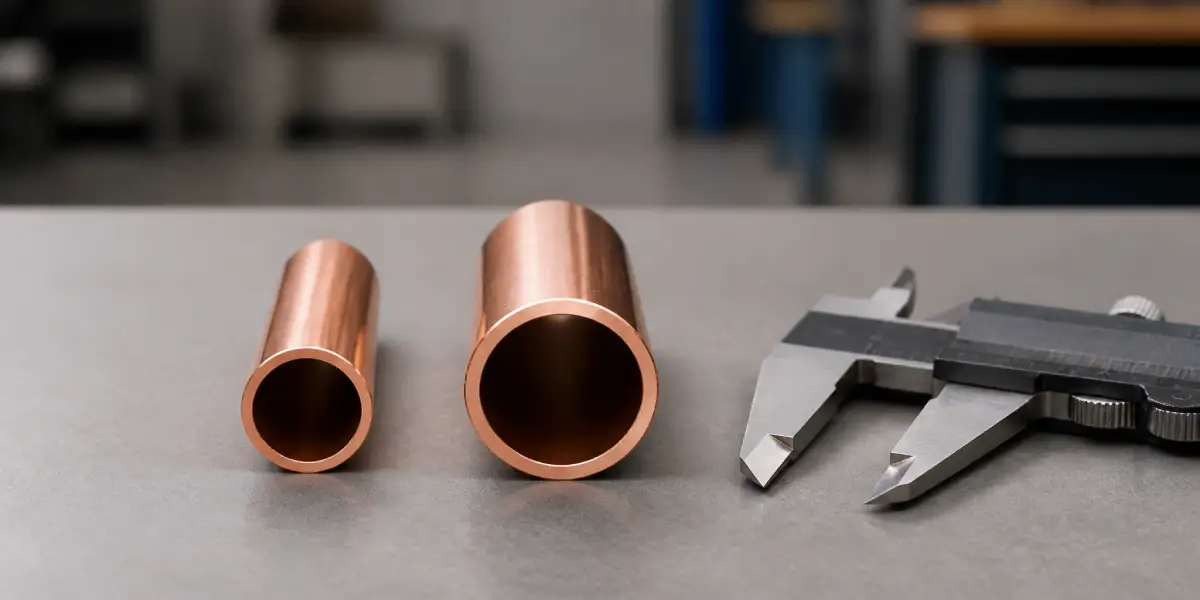
These ACR dimensions should not be read as North American water-tube nominal sizes. For example, a nominal 1/2-inch water tube has a 5/8-inch OD. A request shortened to “half-inch copper” can therefore point to different physical products.
We would resolve that naming convention before matching fittings or discussing alternatives. A supplier serving several markets may use familiar shorthand that the buyer interprets differently. Put actual OD in the order where it helps identify the connection requirement.
For mixed warehouse inventory, use distinct item descriptions for the two systems. It is easier to prevent an incorrect pick with a clear product code than to correct the issue after the installer has opened a package and prepared the wrong connection.
What to Know About Each Copper Tube Size
1/4-Inch Copper Tube
The 1/4-inch OD designation converts to 6.35 mm. It identifies the outer dimension of the bare copper. A buyer still needs the specified wall and product standard to define the tube, along with the equipment requirement that establishes its use.
Small tube can be easy to mishandle because a short piece may look simple to bend or straighten. Use the approved process and inspect the relevant geometry rather than treating the size as permission for unrestricted manual forming.
When ordering 1/4-inch tube as one leg of a pair, identify its length and end condition separately. Confirm whether both legs arrive with the same supplied length and whether prepared connections are included. This prevents a pair description from concealing a difference in what the installation team will receive.
3/8-Inch Copper Tubing
The exact 3/8-inch OD conversion is 9.525 mm. Catalogs may display 9.52 or 9.53 mm, and some equipment instructions use a shorter rounded value. Check the original series before treating that display difference as a different product.
A separately specified 10 mm OD tube has a different designated diameter. Do not substitute it on the strength of a nearby rounded number. Confirm the connection manufacturer’s permitted dimensions and the project’s acceptance requirements.
For purchasing, keep the supplier’s full dimensional description with the item. If a stock label only says “3/8,” add the product family, wall, and material condition in the controlled record. Those fields make the item distinguishable from other tubing that shares the same outside diameter but serves a different requirement.
1/2-Inch Copper Tube
The 1/2-inch ACR OD is 12.70 mm. Its bore depends on the selected wall. An offer that changes wall thickness changes the internal geometry even when the outside size remains the same.
As a hypothetical illustration, a 12.70 mm OD tube with a 0.90 mm uniform wall has an ideal 10.90 mm ID. This is a calculation example, not a recommended wall for an air conditioner. The actual product and system requirements must establish the wall to order.
We recommend asking suppliers to list any proposed wall change explicitly. A phrase such as “same half-inch tube” can hide that difference in a revised quotation. Keep OD, wall, and material condition visible so the technical reviewer can assess what the alternative really changes.
5/8-Inch Copper Tube
The 5/8-inch OD converts exactly to 15.875 mm and commonly appears as 15.88 mm in two-decimal descriptions. It shares a physical OD with a nominal 1/2-inch North American water tube, but matching diameter alone does not establish service equivalence.
Check the permitted forming and connection arrangement for the actual tube. The required tooling, wall, and material condition should match the installation or fabrication process. A larger-looking tube is not automatically more suitable for a particular route.
When adding insulation, review the finished envelope as well as the bare OD. The available space must accommodate the specified covering and installation method. A fitting can match the copper, while the insulated assembly still creates a clearance problem at a cover, support, or wall penetration.
How to Read Common Copper Line-Set Pairs
A Pair Label Contains Two Diameters
Paired descriptions identify two copper legs. The examples below decode the notation only; they are not a recommended size schedule for any equipment capacity.
| Pair notation | First copper OD | Second copper OD | What remains to specify |
|---|---|---|---|
| 1/4 × 3/8 inch | 6.350 mm | 9.525 mm | Both walls, length and construction |
| 1/4 × 1/2 inch | 6.350 mm | 12.700 mm | Both walls, length and construction |
| 3/8 × 5/8 inch | 9.525 mm | 15.875 mm | Both walls, length and construction |
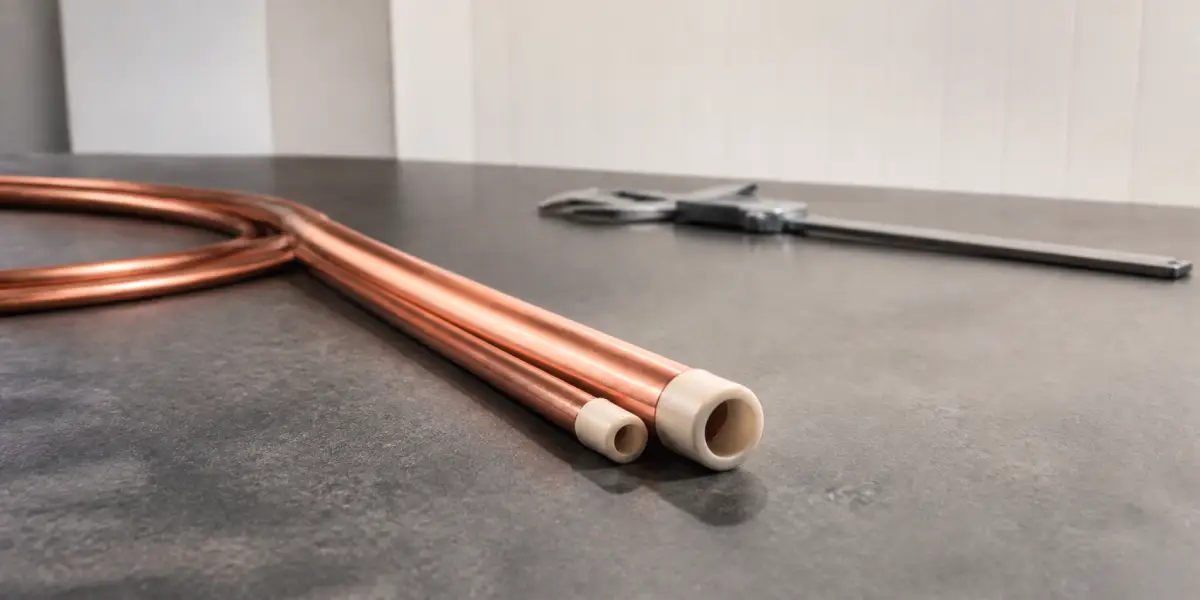
For insulated copper pair coils, confirm which construction the quotation includes. The size pair does not define insulation material, thickness, jacket, or prepared ends. Those need their own order fields so competing offers cover the same product.
Keep Insulation and Length Visible
A line-set order should identify the supplied length and how each leg is insulated. If the installation uses prepared ends, specify the connection details and their protection. Avoid assuming that every product with the same pair label is ready for the same installation process.
An example from Nexnice’s publicly listed ACR coil page shows 15, 30, and 50 meter lengths alongside these four OD sizes. This is catalog information to discuss when requesting an offer, not a promise of current stock or approval of every wall for every refrigerant.
We would compare the quoted length with the approved route and cutting plan. Buying a longer package may leave useful spare material, but it does not authorize extra installed loops. Retain the equipment’s route requirements when deciding how much material to cut and install.
Which HVAC Applications Use These Copper Sizes?
Equipment Instructions: Select the Pair
Use the exact equipment combination and applicable piping instructions to choose the dimensions. Familiar line-set pairings are useful catalog categories, but they cannot replace the model-specific requirements.
As a documented example, Daikin’s RXSQ24TBVJUA, RXSQ36TBVJUA, and RXSQ48TBVJUA manual lists 5/8-inch gas and 3/8-inch liquid piping between refrigerant branch kits. That instruction belongs to the specified system arrangement. It should not become a universal rule for other equipment or other segments.
The HVAC copper tube selection guide explains how to turn model and route information into a pipe schedule. Give each segment its approved dimensions, then select the commercial product that meets those requirements. This keeps catalog convenience separate from the technical decision.
Replacement Work Needs More Than Matching Ends
An existing line can appear to match the new unit’s connection while still requiring further review. Identify its dimensions and condition, then check whether reuse is permitted under the new equipment requirements.
The installation team should record the route and any portions that are inaccessible. A visible end measurement does not describe the entire line’s condition or establish that the original installation matches the new system’s requirements.
We would keep the retained and replacement sections distinct in the material schedule. This allows purchasing to quote the correct new quantities while the technical team reviews the existing pipework. If the route or equipment changes, update both sets of records before issuing material to the job.
How to Order These Four Copper Tube Sizes
Use a Separate Item for Each Construction
Two tubes with the same OD may need separate stock codes when the wall, temper, or insulation differs. Clear item descriptions help distributors prevent a visually similar product from becoming an unintended substitution.
- Identify each copper OD and its required wall specification.
- State product standard, edition, and material condition.
- Define supplied length, quantity, and any continuity requirement.
- Add insulation, prepared ends, and protection where required.
- Request the agreed inspection evidence and deviation reporting.
When comparing ACR copper coil products, use that same item structure for every offer. Ask suppliers to identify assumptions instead of filling missing fields silently. The resulting quotation should make clear which product and length the listed price actually covers.
Inspect Against the Controlled Description
Receiving checks should verify the approved description, not just whether the fractional label looks familiar. Agree the measurement and sampling method before shipment so both sides understand how dimensions will be assessed.
- Match package labels to the order’s product and size fields.
- Check agreed sample OD, wall, and length requirements.
- Inspect end protection and visible handling damage.
- Resolve discrepancies before mixing the delivery into stock.
For an uncertain size, first check the naming convention and units. Then compare observed measurements with the controlling limits. Keep an identification issue separate from a damaged sample or an actual wall discrepancy. Each may require a different response, and a clear report helps the supplier investigate the right problem.
Frequently Asked Questions
What is 1/4-inch copper tube in millimeters?
For an actual-OD ACR description, 1/4 inch equals 6.35 mm outside diameter. Confirm that the product uses this sizing convention before ordering. Wall thickness, material condition and service requirements remain separate fields that the fractional size does not define.
Is 3/8-inch copper tubing the same as 10 mm?
No. The exact outside-diameter conversion for 3/8 inch is 9.525 mm. A separately specified 10 mm tube has a different designated OD. Confirm the approved connection dimensions and project requirements before accepting a nearby metric size as a substitute.
Is 1/2-inch copper tube always 12.7 mm OD?
Only when the description refers to actual outside diameter, as in ACR sizing. Nominal 1/2-inch North American water tube has a larger physical OD. Check the product family and standard because the same fractional label can describe different dimensions.
What does a 1/4 × 3/8 line set mean?
It normally identifies the outside diameters of two copper tubes. It does not fully specify their walls, length, insulation or connections. Request those details separately because products with the same pair label can have different supplied constructions and installation requirements.
Can I choose a line set by air-conditioner capacity?
Use the exact equipment instructions rather than capacity alone. The approved sizes can depend on the model combination, route and branch arrangement. A familiar size pairing is a product description, while the installation schedule must establish where that pair is suitable.
Request a Quote
Send Nexnice the required tube sizes or approved pair, wall requirements, supplied lengths and quantities. Include insulation and connection details if needed. Request an HVAC copper tube quotation to compare a clearly defined product before placing the order.